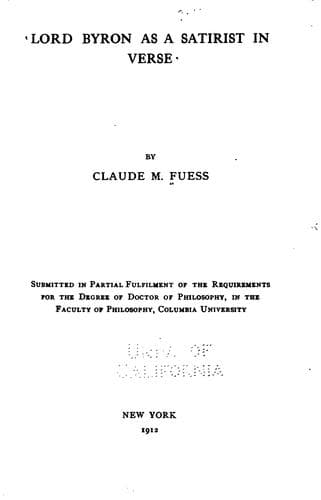
Lord Byron as a satirist in verseFuess, Claude Moore
History
Lord Byron as a satirist in verse
Fuess, Claude Moore
Byron, George Gordon Byron, Baron, 1788-1824 -- Criticism and interpretation; Verse satire, English -- History and criticism
[358] Thus in the _Batrachomyomachia_ the elevated manner of epic
poetry is used in depicting a warfare between frogs and mice; while in
Voltaire’s _La Pucelle_, the French national heroine is made to behave
like a daughter of the streets.
[359] Some examples of the parody are _The Splendid Shilling_ (1701)
by John Philips (1676–1709); _The Pipe of Tobacco_ (1734) by Isaac
Hawkins Browne (1760); _Probationary Odes_; _Rejected Addresses_; and
Swinburne’s _Heptalogia_.
[360] The travesty flourished especially during the 17th century in the
work of Paul Scarron (1610–1660) and his followers in France, and of
Charles Cotton (1630–1687), John Philips (1631–1706), and Samuel Butler
(1612–1680) in England. During this period Virgil and Ovid were popular
subjects for travesty. Several travesties of Homer were published in
England during the 18th century, one of which, by Bridges, was read by
Byron (_Letters_, v., 166).
[361] Charles Lamb said of it that it deserved prosecution far more
than Byron’s _Vision_; and Nichol has styled it “the most quaintly
preposterous panegyric ever penned.”
[362] In his dedication Southey called George IV. “the royal and
munificent patron of science, art, and literature,” and praised the
monarch’s rule as Regent and King as an epoch remarkable for perfect
integrity in the administration of public affairs and for attempts to
“mitigate the evils incident to our state of society.”
[363] _Letters_, v., 387.
[364] _Ibid._, vi., 10.
[365] _Ibid._, vi., 93.
[366] _Letters_, vi., 129.
[367] _Ibid._, vi., 159.
[368] In the only public retort which Southey undertook, a _Letter
to the Courier_, December 8, 1824, he could do little more than make
charges of misrepresentation, and repeat his accusation that Byron
was one “who played the monster in literature, and aimed his blows at
women.” Southey unwittingly had engaged with too powerful an antagonist
and only his want of a sense of humor kept him from appreciating the
fact.
[369] _Letters_, v., 385.
[370] The recurrence in the _Vision_ of many familiar devices of
_Don Juan_ reminds us that the _Vision_ marks Byron’s resumption of
the ottava rima, which he had left off on December 27, 1820, at the
completion of _Don Juan_, Canto V., because of the request of the
Countess Guiccioli that he discontinue the work. In the meantime he
turned his attention to the drama, and _Cain_, _The Two Foscari_, and
_Sardanapalus_ were published in December, 1821. The _Vision_ then was
his only work in the octave stanza between December 27, 1820, and June,
1822, when he began Canto VI. of _Don Juan_.
[371] Byron had finished his translation of the first canto of the
_Morgante_ in February, 1820.
[372] _The Vision of Judgment_, 25.
[373] _Morgante Maggiore_, XXVI., 91.
[374] _History of English Poetry_, v., 250.
[375] _The Vision of Judgment_, 92.
[376] _Letters_, vi., 77.
[377] _Letters_, vi., 160–161.
[378] (this footnote was missing from the original book.)
Public-domain text, read in full here on John Shaqi.
Reviews
Reviews
No reviews yet
Be the first to share your thoughts on this work.
Elsewhere in the archive
Join the Discussion
Join the discussion
Sign in to leave a comment or review.
Sign InorCreate an account