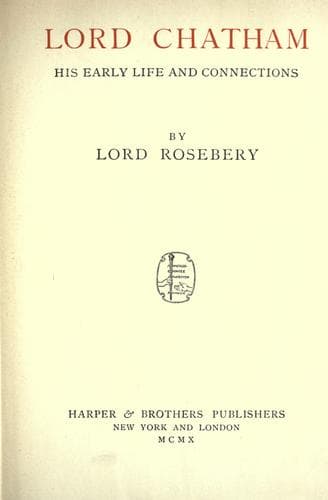
Lord Chatham, His Early Life and ConnectionsRosebery, Archibald Philip Primrose, Earl of
History
Lord Chatham, His Early Life and Connections
Rosebery, Archibald Philip Primrose, Earl of
Pitt, William, Earl of Chatham, 1708-1778
Why did Pitt take this line? If he wished for office (as he undoubtedly
did), it seemed madness: he was committing something like suicide. But
pique, as Sir George Savile well said, 'is the spur the devil rides the
noblest tempers with.' He was unquestionably angry at his exclusion from
office, which he had, no doubt, been told was due to the King. He was
justly indignant that the long-continued efforts which had resulted in
the overthrow of Walpole's overweening power had simply resulted in the
shuffle of a few offices, and that to the victors the spoil had been
denied; the sole and execrable minister Walpole had been replaced by a
much less sole but not less execrable minister in Carteret. All this was
gall to a man who had been among the most formidable in the heat of
battle. That heat was now over, and the vanquished were picnicking with
a few selected victors, while Pitt and his friends were left to cool
themselves on the deserted battlefield. 'They tell me,' said Lord George
Bentinck, in 1846, 'that I shall save fifteen hundred a year by Free
Trade. I don't care for that. What I cannot bear is being sold.' Pitt,
too, could not bear being sold.
That pique and a not ignoble rage had much to do with this philippic we
may well assume. But we may also surmise that his attitude was not
devoid of calculation. The veto of George II. was not to be removed by
deference, so he would, like another Hannibal, destroy the obstacle
with vinegar. The King had been exasperated by the lambent play of
Pitt's earlier insinuations; he should be made to know how Pitt had then
held his hand, what thunderbolts he had kept in reserve, what
unspeakable things awaited the Prince who should frown on him. 'All the
things I have told you,' said Sancho Panza, 'are tarts and cheese-cakes
to what remains behind.' George II. should learn that the innuendoes
that Pitt had levelled at him before were tarts and cheesecakes compared
to what he had the power of producing. Pitt, in a word, had made up his
mind that his only means of achieving his objects was by terror. He had
thrown away the scabbard. Moreover, he was appealing from the Court to
the people. The Court was foreign, immoral, and unpopular: the very name
of Hanover was detested. And although Pitt's actual words reached the
people late or not at all, there was an echo which was audible, and made
known all through the three kingdoms that there was within the walls of
Parliament an intrepid, unbribed, perhaps incorruptible orator who
feared the face of no man, and who was embodying in fiery words the
antipathies and distrusts of the nation.
CHAPTER VIII.
Let us consider for a moment the character of the Sovereign whom Pitt
had set himself to bait.
Public-domain text, read in full here on John Shaqi.
Reviews
Reviews
No reviews yet
Be the first to share your thoughts on this work.
Elsewhere in the archive
Join the Discussion
Join the discussion
Sign in to leave a comment or review.
Sign InorCreate an account