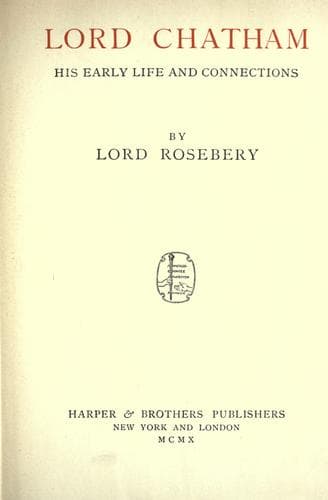
Lord Chatham, His Early Life and ConnectionsRosebery, Archibald Philip Primrose, Earl of
History
Lord Chatham, His Early Life and Connections
Rosebery, Archibald Philip Primrose, Earl of
Pitt, William, Earl of Chatham, 1708-1778
George II. was first and fundamentally a German prince of his epoch.
What other could he be? And these magnates all aped Louis XIV. as their
model. They built huge palaces, as like Versailles as their means would
permit, and generally beyond those limits, with fountains and avenues
and dismally wide paths. Even in our own day a German monarch has left,
fortunately unfinished, an accurate Versailles on a damp island in a
Bavarian lake. In these grandiose structures they cherished a blighting
etiquette, and led lives as dull as those of the aged and torpid carp in
their own stew-ponds. Then at the proper season, they would break away
into the forest and kill game. Moreover, still in imitation of their
model, they held, as a necessary feature in the dreary drama of their
existence, ponderous dalliance with unattractive mistresses, in whom
they fondly tried to discern the charms of a Montespan or a La Vallière.
This monotonous programme, sometimes varied by a violent contest whether
they should occupy a seat with or without a back, or with or without
arms, represented the even tenor of their lives.
George II. was better than this training would suggest. His first
ambition indeed was to be a Lovelace, but his second was to be a
soldier. As a soldier he had the unaffected courage of the princes of
his race. George, red and angry, fighting on foot at the battle of
Dettingen, is a figure that is memorable and congenial to his British
subjects.
As a Lovelace he lives to this day, for his portraits are generally in
the posture of a coxcomb, with his face in outline wearing an
irresistible smile, only comical to the beholder now, but with which he
goes smirking into the eternities. It is not necessary to dwell on this
part of his character; after all, a shallow part, for the one woman whom
he loved was his wife. It was, however, a necessary part, vital to his
conception of an ideal monarch. His confidences to his wife on this
delicate point, though gross to us, seemed natural to him and to her,
and were probably not alien to the atmosphere in which he was reared.
Withal he bored his mistresses to death, and not impossibly they bored
him. But that did not matter; the thing had to be done; he saw himself
as in a mirror the fourteenth or fifteenth Louis; and when on the
Saturdays in summer he drove down with Lady Yarmouth and his court to
Richmond, escorted by Lifeguards kicking up the dust, to walk an hour in
the garden, dine, and return to London, he imagined himself, as Horace
Walpole tells us, the most gallant and lively prince in Europe![144]
We must admit then that he was born and bred a coxcomb, like his son.
That he was a fond father no one will allege. His pleasures were coarse
and dull. Even here one strange exception must be made. His letters to
women, in the opinion of hostile critics, were tender and even
exquisite.[145] How he came to write them we cannot know, for his
character could not make one expect a grace of this kind.
Public-domain text, read in full here on John Shaqi.
Reviews
Reviews
No reviews yet
Be the first to share your thoughts on this work.
Elsewhere in the archive
Join the Discussion
Join the discussion
Sign in to leave a comment or review.
Sign InorCreate an account