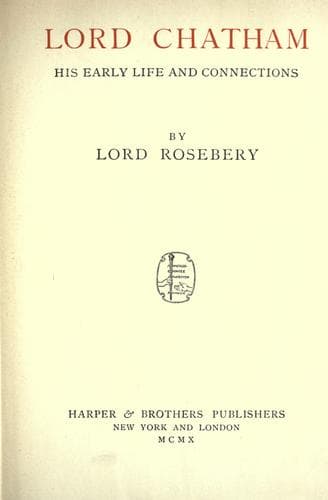
Lord Chatham, His Early Life and ConnectionsRosebery, Archibald Philip Primrose, Earl of
History
Lord Chatham, His Early Life and Connections
Rosebery, Archibald Philip Primrose, Earl of
Pitt, William, Earl of Chatham, 1708-1778
The fact is that George II. had the misfortune to keep in his inmost
circle a vigilant and deadly enemy. John Lord Hervey, the Sporus of
Pope's blighting satire, akin in mind and probably in blood to Horace
Walpole, was always with him; noting down, with spruce rancour, a
venomous pen, and some dramatic power, the random outbreaks of his
master. It is not wise to attribute literal exactitude or even general
veracity to such chronicles; the man who can commit so gross a breach of
confidence is little worthy of trust. That Hervey in the very heart of
the King's family should have sate down with a pen dipped in vitriol to
portray its most intimate aspects is perhaps our gain but his disgrace.
He was a viper warmed in the bosom of the Court, and stung it to the
full extent of his opportunity and powers. A court is considered fair
game by such reptiles. But it is hard to see why princes, who after all
are human beings, should not be allowed to some extent the same sanctity
of family life which humbler human beings claim and maintain. Hervey was
the intimate associate of the King, the confidential friend of the
Queen, the lover of one of their daughters, he was the tame cat of the
family circle. He thought it seemly to narrate their secrets in so
brutal a fashion that some more decent member of his family tore out and
destroyed the coarsest and bitterest passages. What remains is coarse
and bitter enough. It shows the King and Queen in a most unfavourable
light. But that aspect is fascinating compared to that in which he
presents himself. The story of royalty should not be a Court Circular;
but neither should it be a lampoon, written by a trusted friend. The
only excuse for him is that being devoted to the Queen, who in her way
merited his devotion, he detested the King whom he deemed unworthy of
her. But that does not help the reader who looks to him for facts. The
George II. we know is the George II. of Hervey, and Hervey's Journal
proves the writer to be unworthy of implicit credence.
Chesterfield also drew a character of the King. But when we discount
Chesterfield's studied epigrams, poised with the malignant nicety of one
who hated his subject, there is not much left for discredit.
Public-domain text, read in full here on John Shaqi.
Reviews
Reviews
No reviews yet
Be the first to share your thoughts on this work.
Elsewhere in the archive
Join the Discussion
Join the discussion
Sign in to leave a comment or review.
Sign InorCreate an account