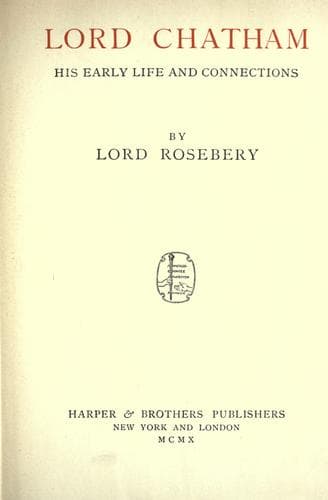
Lord Chatham, His Early Life and ConnectionsRosebery, Archibald Philip Primrose, Earl of
History
Lord Chatham, His Early Life and Connections
Rosebery, Archibald Philip Primrose, Earl of
Pitt, William, Earl of Chatham, 1708-1778
The real crime of George II. in the eyes of his British subjects was
almost in the category of virtues, for it was his devotion to Hanover.
Innocent and natural as it was in him, it seems wonderful to us that our
fathers should have endured it. How they must have hated Popery! But
Hanover was the King's home and fatherland; all his pleasant
associations were with Hanover; there he was absolute Sovereign, and
could lead without criticism the life that he enjoyed. He could not help
being a Hanoverian any more than William III. could help being a
Hollander. The English chose their Dutch and Hanoverian Sovereigns with
their eyes open, and had no right to complain if what they desired and
obtained was somewhat bitter in digestion. Neither William nor the two
first Georges ever professed to be other than what they were; they never
for a moment simulated that they were English, they never pretended to
like England. 'He hated the English,' says Lord Hervey of George II. And
when at the first available instant they fled from Kensington and
Hampton Court to Loo or Herrenhausen, their English subjects ignored
the mortifying preference, from devotion no doubt to the Protestant
Succession; but partly also because these monarchs were profoundly
indifferent to them. With George II., it is true, these excursions were
accompanied, as in Shakespeare, by alarms; alarms only too well founded
that he would return with a pocket full of treaties for subsidies which
the British taxpayer would have to pay. But all these three kings
accurately understood their position. They knew that they were not
chosen from affection, or for their qualities, certainly not for their
attractions. They were taken as necessities, almost odious necessities,
to keep out a Romanist dynasty which represented something to the people
that was more odious still.
They entertained, then, no illusions; a bargain had been driven with
them and they would keep it; they gave their pound, or more, of flesh.
They would occupy palaces, receive civil lists, interview ministers, and
keep out the Pretender. But that did not imply a perpetual exile from
home; they intended to get as many holidays as possible; and they did.
They might be a hateful necessity for England, but England as a
necessity was almost as hateful to them. Their life in this island was
servitude, more or less penal; they only breathed by the dykes of
Holland or the waters of the Leine. If this be clearly understood, much
confusion and vituperation may be avoided. But the wonder is that the
English (for the Scots and Irish had little to do with it) should have
had the civic courage in the cause of religion and liberty to endure the
compact.
Public-domain text, read in full here on John Shaqi.
Reviews
Reviews
No reviews yet
Be the first to share your thoughts on this work.
Elsewhere in the archive
Join the Discussion
Join the discussion
Sign in to leave a comment or review.
Sign InorCreate an account