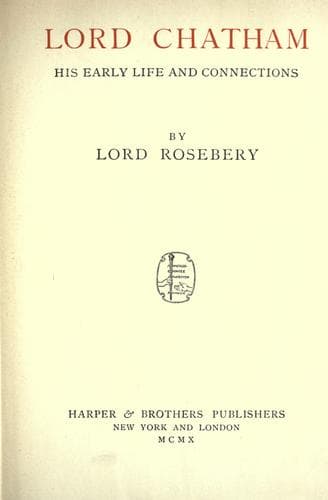
Lord Chatham, His Early Life and ConnectionsRosebery, Archibald Philip Primrose, Earl of
History
Lord Chatham, His Early Life and Connections
Rosebery, Archibald Philip Primrose, Earl of
Pitt, William, Earl of Chatham, 1708-1778
George II. then, we contend, putting his private life apart, which we
must judge by the German standard of those days, was not a bad King
under the conditions of his time and of his throne. He was perhaps the
best of the Georges; better than George I. or George IV., better as a
King than George III., though inferior no doubt in the domestic virtues.
All things considered, it is wonderful that he was as good as he was,
and he scarcely deserves the thoughtless opprobrium which he has
incurred.
CHAPTER IX.
And now it is necessary to say a word of Continental affairs.
A life of Pitt should concern itself with Pitt alone, or with the
persons and events immediately relating to him. But as during this
period of his life foreign policy was all in all, and Britain seemed a
mere anxious appendage to the Continent, it is necessary to give a
succinct sketch of the familiar but complicated sequence of events in
Europe which occurred at this time, and which inspired almost all the
debates in which Pitt took part.
Walpole, as we have seen, had declared war against Spain in 1739, and
the not very glorious course of those operations does not call for
record. But the year 1740 marked a new and critical epoch. Death in
those few months was busy lopping off the crowned heads of Europe, as if
to clear the scene for two great figures. On February 6 died Pope
Clement XII. On March 31 died the shrewd but brutal boor Frederick
William I., and at the age of twenty-eight his son Frederick II. reigned
in his stead. His accession was to unveil a mystery; and where mankind
had hitherto seen a fiddling dilettante, contemptuous of his countrymen
and craving for all that was French, to reveal the direct ancestor of
German unity, the most practical and tenacious of conquerors. On
October 20 the Emperor Charles VI., the figure-head for which we had
fought in the War of the Succession, and, a week afterwards, Anne the
Empress of Russia passed away. Rarely has the sickle of Eternity
gathered so pompous a harvest. Between February and November it had
garnered the Holy Roman Emperor, the Holy Roman Pontiff, the sovereign
of Russia, and the sovereign of Prussia. Of these the death at Vienna
was by far the most momentous. For Charles left behind him no son, but a
young daughter of twenty-three, about to be a mother, whose succession
he had attempted to secure by the Pragmatic Sanction of 1718, ratified
and recognised by solemn international instruments. On the morning of
his death she was promptly proclaimed sovereign of her father's
dominions; but her treasury was empty and her ministers paralysed.
Bavaria at once protested. Behind Bavaria stood Frederick armed to the
teeth, eager to let slip the dogs of war. Every one saw his
preparations; no one could tell at whom they were aimed.
Public-domain text, read in full here on John Shaqi.
Reviews
Reviews
No reviews yet
Be the first to share your thoughts on this work.
Elsewhere in the archive
Join the Discussion
Join the discussion
Sign in to leave a comment or review.
Sign InorCreate an account