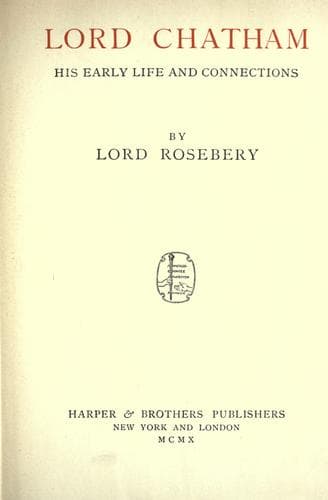
Lord Chatham, His Early Life and ConnectionsRosebery, Archibald Philip Primrose, Earl of
History
Lord Chatham, His Early Life and Connections
Rosebery, Archibald Philip Primrose, Earl of
Pitt, William, Earl of Chatham, 1708-1778
This victory brought into the arena new and eager claimants for some
part of the Austrian spoils, now apparently so available. The eminent
guarantors of the integrity of Austria were suddenly transformed into
hungry schemers for her immediate partition. Spain, Sardinia, and
Poland-Saxony all advanced pretensions. But a mightier enemy was
preparing to join hands with Frederick and take the field; for it was
scarcely to be supposed that the secular enemy of the House of Hapsburg
could remain quiescent at such a moment. France saw a unique opportunity
for breaking up the Austrian dominions, and reducing the portion
reserved to the young Queen to comparative insignificance. In France, as
in England, the Minister was peaceful, but the party of war carried the
day. Two French armies of 40,000 men each crossed the Rhine in August
1741. One under Marshal Maillebois marched on Hanover. The ruler of that
State, who, as sovereign of Great Britain, was the active ally of Maria
Theresa, hastily concluded a treaty of neutrality for one year,
promising to give no assistance to the young Queen in his Hanoverian
capacity, and to refrain from voting for her husband as Emperor. For
this treaty George II. was violently attacked by his British subjects,
who believed themselves to be fighting for Hanoverian interests, while
Hanover itself was thus snugly removed into a haven of peace. The
censure was, we think, excessive, if not undeserved. The treaty did
indeed accentuate the duality which somewhat unequally divided the
person of George. But if that be once conceded, it must be admitted that
he was right as Elector to do his very best for Hanover, just as King he
was bound to do his very best for England. As Elector, then, he was
fully justified in keeping his defenceless State out of the devastation
of war, from which it was destined to suffer so terribly sixteen years
later from another French army under the Duke of Richelieu, when
neutrality was no longer possible.
While Maillebois marched towards Hanover, the other army, under Marshals
Belleisle and Broglie, marched through Bavaria and menaced Vienna.
Maria Theresa had to fly to Hungary, and appeal in a manner made
familiar by description to the chivalry of the Magyars. The Elector of
Bavaria, who was the figure-head chosen by the confederates for the
imperial throne, and who had his fill of titles in the lack of more
substantial fare, was proclaimed Archduke of Austria at Linz, King of
Bohemia in Prague, and soon afterwards Emperor in Frankfort. It seemed
as if a vast partition was about to take place, and the House of Austria
destined to disappear.
Public-domain text, read in full here on John Shaqi.
Reviews
Reviews
No reviews yet
Be the first to share your thoughts on this work.
Elsewhere in the archive
Join the Discussion
Join the discussion
Sign in to leave a comment or review.
Sign InorCreate an account