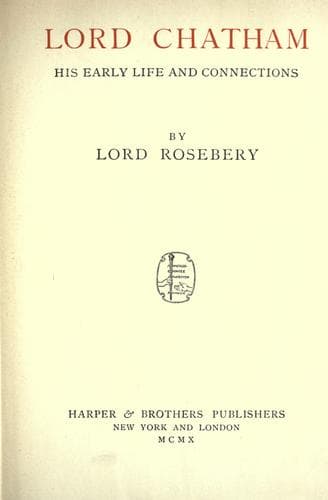
Lord Chatham, His Early Life and ConnectionsRosebery, Archibald Philip Primrose, Earl of
History
Lord Chatham, His Early Life and Connections
Rosebery, Archibald Philip Primrose, Earl of
Pitt, William, Earl of Chatham, 1708-1778
But this was the turning-point; in the general blackness there appeared
rays of hope for Maria Theresa. Walpole, the peace minister,
disappeared, and the control of Foreign Affairs in Great Britain passed
to Carteret, who was warm for Austria, and eager to play an active part
on the Continent. Moreover, the misfortunes of the Queen roused the
enthusiasm of Great Britain. Five millions were voted for the war, half
a million as a subsidy to the Queen of Hungary. Sixteen thousand men
were sent into Flanders to assist the exertions of the Dutch.
Unfortunately there were no exertions to assist, and our troops remained
useless. Our fleets were more active. They harried the Spaniards and
controlled the Mediterranean. A squadron entered the Bay of Naples and
gave the King, afterwards Charles III. of Spain, an hour in which to
decide whether he would abandon the confederacy against Austria or see
his beautiful city bombarded. The King of Naples yielded, but as King of
Spain never forgave the English for this humiliation.
[Sidenote: Feb. 12, 1742.]
The Austrians, too, found a bold and skilful general in Khevenhüller,
who seized Bavaria and occupied Munich on the very day on which its
ruler was crowned Emperor. In the succeeding June a peace, which proved
afterwards to be but a truce, was concluded at Breslau between Austria
and Prussia, through the mediation of Great Britain, and followed by the
Treaty of Berlin, to which George II. both as King and Elector, the
Empress of Russia, the States General, and the King of Poland as Elector
of Saxony were parties. There had been a secret armistice between the
two states in the winter of 1741, by which Lower Silesia and Niesse had
been ceded to Frederick, but this had soon proved inoperative. A new
situation was however produced by the severe battle of Chotusitz, in
which the Austrians suffered defeat at the hands of Frederick. Maria
Theresa now yielded to the pressure of the English ministry and ceded
all Lower and part of Upper Silesia with the county of Glatz to
Frederick, who in return abandoned his allies and left the French to
themselves, on the plea that they were in secret communication with
Vienna. Saxony, under his influence, also withdrew from the war, and the
King of Prussia and the Elector of Hanover concluded a defensive
alliance, the Elector guaranteeing Silesia and Glatz to the King.
Frederick saw that he had been too successful. He was determined to
retain Silesia, but he saw with apprehension great French armies
overrunning the German Empire. That France should be aggrandised at the
expense of Germany was no part of his policy. For Germany as Germany he
had no natural affection; but the waters of Germany, however troubled
they might be, he proposed to keep for his own fishing.
[Sidenote: Dec. 1741.]
Public-domain text, read in full here on John Shaqi.
Reviews
Reviews
No reviews yet
Be the first to share your thoughts on this work.
Elsewhere in the archive
Join the Discussion
Join the discussion
Sign in to leave a comment or review.
Sign InorCreate an account