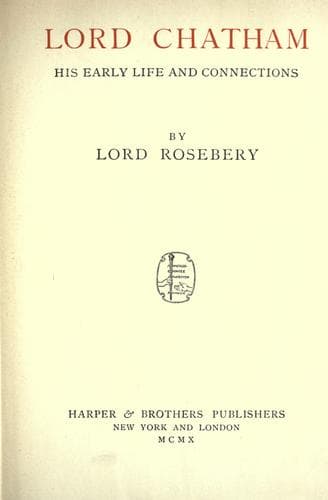
Lord Chatham, His Early Life and ConnectionsRosebery, Archibald Philip Primrose, Earl of
History
Lord Chatham, His Early Life and Connections
Rosebery, Archibald Philip Primrose, Earl of
Pitt, William, Earl of Chatham, 1708-1778
To meet this combination, Louis XV., on the advice of his Minister but
against his own better judgment, signed one of those one-sided and
altruistic treaties which characterised French policy at this time, and
renewed the family compact of 1733 by a treaty signed at Fontainebleau
in October 1743. In this new edition the Bourbons of France and Spain
pledged themselves to an indissoluble union. France was to declare war
against Great Britain and Sardinia, to help Spain to reconquer Parma and
the Milanese for Don Philip, and to compel Great Britain to give up her
colony of Georgia. Finally, the two Powers were not to make peace until
Gibraltar and, if possible, Minorca were restored to Spain.[148]
[Sidenote: May 1744.]
But the Austrian successes once more brought Frederick into the field
to redress the balance, which now inclined too much to Austria, as it
had inclined too much to France. Austria had acquired Bavaria for the
moment, and perhaps would never evacuate it; she might be encouraged to
attempt the reconquest of Silesia. Her armies were now in Alsace; where
would they stop? The Queen, he knew, was only a degree less tenacious
than himself. So he signed a new convention at Frankfort with the
Emperor, the King of France, the King of Sweden as Landgrave of Hesse,
and the Elector Palatine, and again took up arms against Austria, which
was almost drained of troops. France about the same time formally
declared war against Great Britain and Austria, whom she had been
fighting, so to speak, incognito, for three years past. On the other
hand a quadruple alliance was concluded between Great Britain, Austria,
Holland, and Saxony; based as usual on British subsidies, which
Parliament ungrudgingly voted, with the eloquent but surprising support
of Pitt.
Here begins the third period of the war. Louis XV. and Marshal Saxe at
the head of 80,000 men entered the Austrian Netherlands almost without
resistance. Frederick soon made himself master of Bohemia and Bavaria,
and returned the Electorate to its sovereign, the Emperor Charles VII.
In January 1745, worn out with misfortunes and anxieties and dignities,
but once more in his capital, that hapless monarch died. Within three
months his successor had concluded peace with Austria through the
earnest pressure of the British Cabinet on the haughty Queen; the
Elector abandoning his claims on the Austrian dominions, and promising
his vote for the Empire to Maria Theresa's husband. Peace between
Austria and the King of Poland, Elector of Saxony, followed in May,
when the contracting parties entered into a premature concert for the
partition of the Prussian dominions.
Public-domain text, read in full here on John Shaqi.
Reviews
Reviews
No reviews yet
Be the first to share your thoughts on this work.
Elsewhere in the archive
Join the Discussion
Join the discussion
Sign in to leave a comment or review.
Sign InorCreate an account