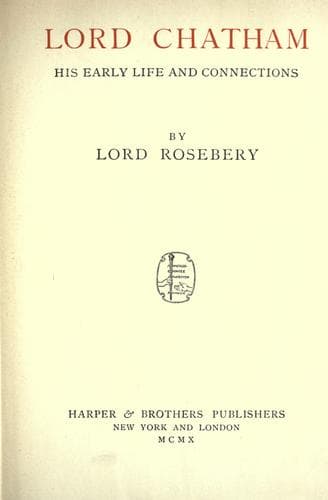
Lord Chatham, His Early Life and ConnectionsRosebery, Archibald Philip Primrose, Earl of
History
Lord Chatham, His Early Life and Connections
Rosebery, Archibald Philip Primrose, Earl of
Pitt, William, Earl of Chatham, 1708-1778
Otherwise 1745 was a disastrous year for Austria. The Allies, Austrians,
British, and Dutch, under the Duke of Cumberland, sustained a bloody
defeat at Fontenoy in May; and Great Britain, occupied with the domestic
disturbance caused by the landing of Charles Edward, had to withdraw
from active participation in the war. In August a secret convention was
concluded at Hanover between the Kings of Prussia and Great Britain, by
which the latter Power guaranteed Silesia to the former. This was the
beginning of the end. The British Ministry now notified to the
unyielding Queen that she must come to terms with her enemy, or expect
no more assistance from England or Holland. The Austrian arms met
everywhere with reverses. While the young Queen was planning with Saxony
a triumphant march on Berlin, Frederick broke into Saxony and occupied
Dresden. On this final blow Maria Theresa accepted the mediation of
Great Britain and signed, on Christmas Day, 1745, the peace of Dresden
which gave Silesia and Glatz to Frederick. So ends the third period of
this strange and erratic war; a labyrinth of fugitive conventions and
transient alliances, with two strong purposes in the centre.
But the auxiliary combatants remained at strife, just as the seconds in
a duel have sometimes fought after their principals had settled their
own differences. And so we now enter on its fourth period, that in which
the British, Austrians, and Dutch (with the assistance of the
Piedmontese in Italy) contended against France and Spain. The part of
this war which chiefly concerns Great Britain was fought in Flanders.
And in all these transactions it must be noted that a main difficulty of
the British Ministry, both from the practical and from the parliamentary
point of view, lay in the problem of moving the Dutch. The Hollanders
had everything to apprehend from the triumph of the French arms, but
their phlegmatic temper, and still more the impracticable nature of
their constitution, offered great obstacles to their co-operation.
Anglers may see an analogy between these British negotiations with the
Dutch and the tardy and tantalising sport of sniggling for eels. At the
beginning of 1746, matters seemed to have come to a climax. The French
were harrying Flanders, and were threatening to invade Holland. The
Dutch Government were now stirred into proposing active measures, and
the raising of a large army, to be under the command of the Prince of
Waldeck; but they declined to declare war against France. The British
agreed to a joint force of 100,000 men, comprising 40,000 to be
furnished by the States-General, 30,000 by Austria, some Hanoverians and
Saxons to be paid by England and Holland, and 6000 Hessians to be
provided by England after Charles Edward had been finally defeated. The
Dutch regarded the British offers as inadequate; for it is a cardinal
principle of all Continental wars in which Great Britain is concerned
Public-domain text, read in full here on John Shaqi.
Reviews
Reviews
No reviews yet
Be the first to share your thoughts on this work.
Elsewhere in the archive
Join the Discussion
Join the discussion
Sign in to leave a comment or review.
Sign InorCreate an account