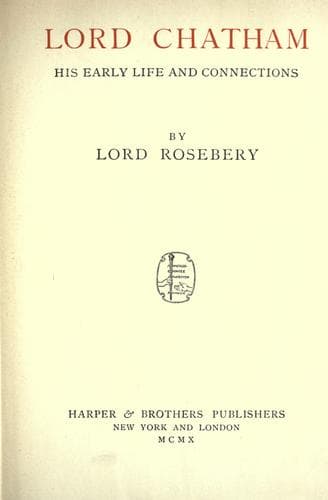
Lord Chatham, His Early Life and ConnectionsRosebery, Archibald Philip Primrose, Earl of
History
Lord Chatham, His Early Life and Connections
Rosebery, Archibald Philip Primrose, Earl of
Pitt, William, Earl of Chatham, 1708-1778
No more of Pitt's speeches are recorded during the session, which, with
the enviable ease of those days, having opened on November 16, 1742,
closed on April 21, 1743. In the interval before the ensuing session an
event occurred, not in itself memorable, but notable for the contest
that followed. In July 1743 occurred the long-expected death of
Wilmington, the nominal head of the Government. In itself this departure
would not have caused a ripple on the surface of politics, but it opened
a critical succession. Pulteney, now Earl of Bath, at once laid claim to
it; and his pretensions were warmly supported by Carteret, who was the
minister in attendance on the King in Germany. Henry Pelham, supported
by his brother Newcastle, also applied for the vacant post. As between
these two groups it seemed certain that Bath, through Carteret, who was
on the ground, would have the preference. Pelham, indeed, at the
instance of Walpole, had, before the King left England, applied to his
Majesty for the reversion of the moribund Minister's place, and had, if
Coxe may be trusted, received a definite promise. It seems difficult to
credit this, for George was a man of his word, yet the Pelham brothers
were unfeignedly astonished when the reversion was given them; so that
had Pelham indeed received such a pledge, he must have expected that
the King would break it. Six weeks of dire suspense followed the death
of Wilmington; an interval which was probably caused by the anxiety of
the Sovereign to consult Walpole, while he intimated to Pelham that his
decision would be conveyed to the Ministry by Carteret. This seemed a
deathblow to the chances of Pelham, though the King's aversion to Bath
was notorious. But a letter at length arrived from Carteret, in which he
announced, with unaffected regret but with a generous promise of
support, that the prize had fallen to Pelham. The brothers were elated,
if such an expression can ever be applied to the timid and cautious
Pelham. Newcastle was transported by the 'agreeable but most surprising
news;' so much so, as to acknowledge that Carteret's letter was 'manly.'
Public-domain text, read in full here on John Shaqi.
Reviews
Reviews
No reviews yet
Be the first to share your thoughts on this work.
Elsewhere in the archive
Join the Discussion
Join the discussion
Sign in to leave a comment or review.
Sign InorCreate an account