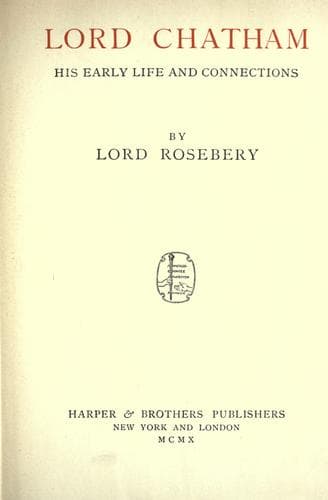
Lord Chatham, His Early Life and ConnectionsRosebery, Archibald Philip Primrose, Earl of
History
Lord Chatham, His Early Life and Connections
Rosebery, Archibald Philip Primrose, Earl of
Pitt, William, Earl of Chatham, 1708-1778
Walpole, in writing his congratulations, looked warily to the future.
'Recruits,' he advised, should now be sought 'from the Cobham
squadron.... Pitt is thought able and formidable, try him or show
him.... Whig it with all opponents that will parley, but 'ware Tory.'
Newcastle, on reading this letter to his brother, wrote back: 'I am
afraid, one part of it, viz. the taking in of the Cobham party and the
Whigs in opposition, without a mixture of Tories, is absolutely
impracticable; and, therefore, the only question is whether, in order to
get the Cobham party, etc., you will bring in three or four Tories, at
least, with them, for, without that, they will not come, and this is
what I have the greatest difficulty to bring myself to.' Orford's advice
was not followed, and Pelham's appointments were few and narrow. Two of
Lord Bath's followers, a friend of the Prince of Wales, and a friend of
his own, the only surviving name of the four, Henry Fox, were
gratified, and that was all. And even this limited arrangement was not
completed before Parliament met.
[Sidenote: Dec. 1, 1743.]
The opening of the new session was anticipated with keen interest, as
the Ministry was known to be rent with divisions, and hatred of the
Hanoverians had immeasurably swollen in consequence of rumours of the
favour that the King had shown to his electoral subjects. He had been
surrounded by Hanoverian Guards to the exclusion of the English Guards;
he had worn at Dettingen a yellow sash, which it appears was a
Hanoverian symbol of authority; the Hanoverians had refused to obey the
orders of Lord Stair, and so forth. We can easily imagine the buzz of
angry legend and comment; for national antipathies have no difficulty in
obtaining substantial affidavits in their support. Of this wild but not
unreasonable intemperance Pitt, it is scarcely necessary to say, was the
mouthpiece. In the debate on the Address he spoke with his accustomed
violence. He called Carteret 'an execrable or sole minister, who had
renounced the British nation, and seemed to have drunk of the potion
described in poetic fictions which made men forget their country.'[151]
So far as this tirade concerned Carteret's authority, nothing could be
more absurd or wide of the truth. He could indeed scarcely have chosen a
more unfortunate epithet than 'sole.' So far from being a sole minister,
Carteret, as we have seen, had just received a crushing defeat in the
elevation of Henry Pelham to the first place in the Ministry, and the
rejection of his own candidate; though he had strained all his influence
in the cause.
Public-domain text, read in full here on John Shaqi.
Reviews
Reviews
No reviews yet
Be the first to share your thoughts on this work.
Elsewhere in the archive
Join the Discussion
Join the discussion
Sign in to leave a comment or review.
Sign InorCreate an account