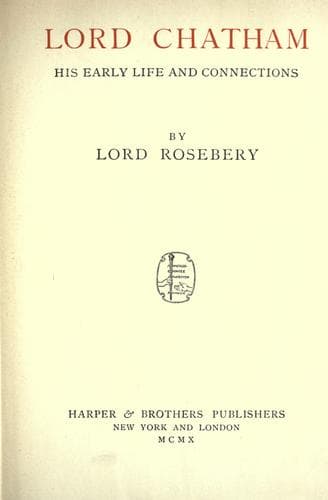
Lord Chatham, His Early Life and ConnectionsRosebery, Archibald Philip Primrose, Earl of
History
Lord Chatham, His Early Life and Connections
Rosebery, Archibald Philip Primrose, Earl of
Pitt, William, Earl of Chatham, 1708-1778
And here another illustrious name cannot but suggest itself, though it
may seem difficult to bring into anything like a parallel the two great
Sir Roberts, Walpole and Peel. Both were distinguished by the same
cautious and pacific sagacity. But they differed by the whole width of
human nature in temperament. Walpole belonged to the school of the cold
blood, and Peel to that of the warm. This, perhaps, constitutes the most
important touchstone in the characters of statesmen, and success usually
lies with the colder temperament. Of this principle, Fox, who was warm
blooded, presents the most remarkable illustration, and Gladstone, who
was not less so, the most signal exception. Peel's conscience, moreover,
was as notably sensitive as Walpole's was notoriously the reverse. But
though thus essentially apart, there is one capital point which the
careers of Walpole and Pitt bear an almost exact resemblance to each
other. Neither of them, strangely enough, reached his full height until
his fall; neither acquired the full confidence of the country until he
had lost that of Parliament; after having exercised almost paramount
power as Ministers, neither ever reached his truest supremacy until he
had left office for ever. Then, after a great catastrophe which had
seemed to demolish them, it was perceived that they had soared above the
mist into a higher air, clear of passion and interest; whence, though
with scarce a following and without the remotest idea of a return to
office, they spoke with an authority which they had never possessed when
their word was law to an obedient majority in the Commons; an authority
derived from experience and wisdom, without any lingering suspicion of
self-interest. They lived in reserve, and only broke their self-imposed
silence when the highest interests of the country seemed to forbid them
to maintain it. Walpole, it is true, had to do his work mainly behind
the scenes, while Peel did it conspicuously in Parliament; but the
position was the same. If their eulogist had to choose the supreme
period in the lives of both Walpole and Peel, he would select, not the
epoch of their party triumphs, but the few exalted judicial years which
elapsed between their final resignation and their death. It may seem a
strain of language to use the word 'judicial,' for Walpole remained the
oracle and stay of Whiggery, while Peel extended his consistent
protection to the weak ministry of Lord John Russell. But Peel's
protection of Russell was given in defiance of party to secure the Free
Trade which he deemed vital, and Walpole's guidance of Whiggery was in
disinterested support of men he disliked and despised because he deemed
Whiggery, or at least opposition to Jacobitism, not less vital. Free
Trade and Whiggery were, in the opinion of the two statesmen, essential
to avert the revolutions which the opposite systems would have involved.
Public-domain text, read in full here on John Shaqi.
Reviews
Reviews
No reviews yet
Be the first to share your thoughts on this work.
Elsewhere in the archive
Join the Discussion
Join the discussion
Sign in to leave a comment or review.
Sign InorCreate an account