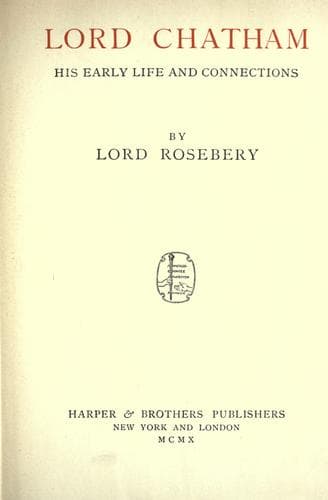
Lord Chatham, His Early Life and ConnectionsRosebery, Archibald Philip Primrose, Earl of
History
Lord Chatham, His Early Life and Connections
Rosebery, Archibald Philip Primrose, Earl of
Pitt, William, Earl of Chatham, 1708-1778
This seems a digression, but at this time Pitt and Walpole were not far
apart; they secretly acknowledged each other's power and merit. Pitt had
already begun to appreciate the solid sagacity of Walpole, and to repent
of some random invective. Walpole saw the rhetorical boy developing
into the man of the future, and was more and more anxious to enlist him.
'Sir Robert Walpole,' said Pitt in Parliament at a later period,
'thought well of me, and died at peace with me. He was a truly English
minister.'[158]
CHAPTER XI.
[Sidenote: March 1744.]
Soon after this memorable debate France formally declared war against
Great Britain in a document reciting the injuries sustained by France at
the hands of the 'King of England, Elector of Hanover,' and faction was
for the moment laid on one side, though Pitt, while supporting the
Government, managed to declare that perdition would attend Carteret as
the 'rash author of those measures which have produced this disastrous,
impracticable war.' Still Parliament adjourned with comparative harmony
in May. Before it met again two events occurred of the greatest
importance to Pitt.
The first was the death of that vigorous old termagant Sarah, Duchess of
Marlborough. All through life she had been more bellicose, though with
less success, than her illustrious husband, and of late years had
devoted her peculiar powers of hatred to Walpole. This bitterness
extended even beyond the grave, for by a codicil dated two months before
her death she bequeathed legacies to the two men who had most
distinguished themselves by their attacks on that Minister. One was
Chesterfield, to whom she left 20,000_l._; the other was Pitt, to whom
she left 10,000_l._, 'for the noble defence he made for the support of
the laws of England, and to prevent the ruin of his country.' Moreover,
she seems to have bequeathed to him her 'manor in the County of
Buckingham, late the estate of Richard Hampden Esq: and leasehold in
Suffolk; and lands etc. in Northampton.'[159] Pitt, in acknowledging the
bequest to Marchmont, her executor, demurely and ambiguously replies:
'Give me leave to return your Lordship my thanks for the obliging manner
in which you do me the honour to inform me of the Duchess of
Marlborough's great goodness to me. The sort of regard I feel for her
memory I leave to your Lordship's heart to suggest to you.'[160] Nor was
this legacy all, for she settled her Wimbledon estate on her favourite
grandson John Spencer, and after him on his only son; should that only
son die without issue, it was to be divided between Chesterfield and
Pitt. She, moreover, induced John Spencer to make a will bequeathing his
own Sunderland estates to Pitt after his own sickly son.[161] Two years
afterwards Spencer himself died at the age of thirty-seven 'because he
would not be abridged of those invaluable blessings of an English
subject, brandy, small beer and tobacco,'[162] so that only a child
stood between Pitt and this great inheritance.
Public-domain text, read in full here on John Shaqi.
Reviews
Reviews
No reviews yet
Be the first to share your thoughts on this work.
Elsewhere in the archive
Join the Discussion
Join the discussion
Sign in to leave a comment or review.
Sign InorCreate an account