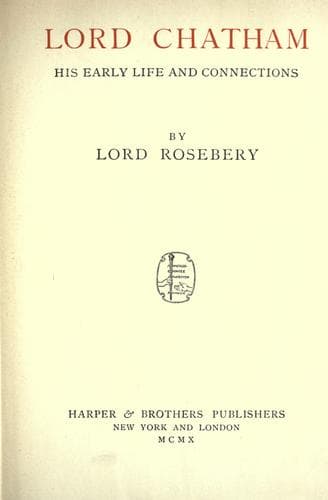
Lord Chatham, His Early Life and ConnectionsRosebery, Archibald Philip Primrose, Earl of
History
Lord Chatham, His Early Life and Connections
Rosebery, Archibald Philip Primrose, Earl of
Pitt, William, Earl of Chatham, 1708-1778
The story of that fall is material to the life of Pitt; it is that
second event of importance to him at this time to which we have alluded.
We have seen that Walpole's last journey to London was caused by the
King's struggle to retain Carteret whom the Pelhams insisted on
removing. This indeed was a matter of necessity for them, as they could
never enjoy real power while Carteret engrossed the King's confidence.
Moreover, owing to the ill success of the Austro-British alliance during
1744 in operations with which he was identified he had become extremely
unpopular. He himself was dissatisfied with his position, for though he
had the ear of the King he was constantly outvoted in the Cabinet.
'Things cannot go on as they are,' he said to the ruling brother. 'I
will not submit to be overruled and outvoted on every point by four to
one. If you will undertake the Government, do so. If you cannot or will
not I will.' This rash declaration of war sealed his fate. As a matter
of fact the main division in the Cabinet of which we have record at this
time was nine to four; but the majority was no doubt steady and
inflexible against Carteret. The brothers now concentrated their
energies on his overthrow. But before making any open attack on so
strong a position, they wisely endeavoured to secure new sources of
strength by negotiation with the Opposition.
During the year 1744 the leaders of the Opposition had reunited, 'upon
one principle,' says the malignant Glover, 'which was to get into
place.' This may fairly be said, without disparagement, to be the
legitimate object of all Oppositions. In any case these politicians may
well have realised that divided and scattered they were impotent, and
they may have desired to make themselves felt in Parliament with or
without office. So they appointed a committee of nine to treat with the
Government. The junto, as it was termed in the jargon of that day,
consisted of Bedford, Chesterfield, Gower, Cobham, Pitt, Lyttelton,
Waller, Bubb, and Sir John Hinde Cotton.[165] This powerful body was
approached by Carteret, always tardy and unskilful in such
negotiations; but he had been anticipated by the brethren in power, who,
in such intrigues, displayed all the skill that he lacked. He obtained,
however, the powerful mediation of the Prince of Wales, who had a regard
for him. Carteret's offers were liberal enough. He offered that the
administration should be transformed, and places found for all of them;
but they replied that they could make no terms with him. He turned, as
we have seen, to Walpole in his despair, but in vain. Every hole was
stopped. The Pelhams had secured both Walpole and the Committee.
Public-domain text, read in full here on John Shaqi.
Reviews
Reviews
No reviews yet
Be the first to share your thoughts on this work.
Elsewhere in the archive
Join the Discussion
Join the discussion
Sign in to leave a comment or review.
Sign InorCreate an account