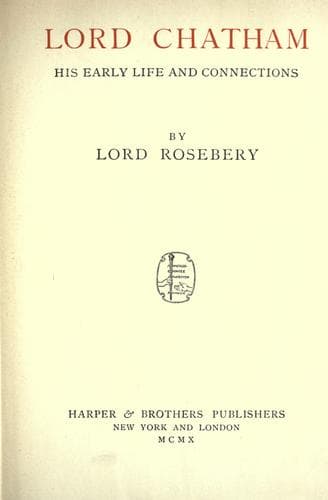
Lord Chatham, His Early Life and ConnectionsRosebery, Archibald Philip Primrose, Earl of
History
Lord Chatham, His Early Life and Connections
Rosebery, Archibald Philip Primrose, Earl of
Pitt, William, Earl of Chatham, 1708-1778
Five of the junto, including Pitt and Lyttelton, were, it is said, in
favour of joining the Pelhams without any stipulation. The minority,
including Cobham, who considered that the pass had been sold, and who
cursed the less scrupulous tactics of the majority, were for making
conditions as regards future policy. However, all, both of the majority
and the minority, were brought into the scheme; Cobham, who received a
regiment, having, it is said, also obtained an assurance from Newcastle
that the interests of Hanover should be subordinated to the interests of
Great Britain. Bedford became First Lord of the Admiralty; Gower, Privy
Seal; Waller, Cofferer; Lyttelton, a Lord of the Treasury; Bubb,
Treasurer of the Navy; and Cotton, a notorious Jacobite, Treasurer of
the Chambers. It should be added, however, that the narrative of this
negotiation, however probable it may appear, rests on the doubtful
authority of Glover, who is too venomous to be trustworthy. But in any
case it is not necessary to condemn the Committee, even if Glover's
statement be accepted as fact. Should so powerful a body of men enter
the feeble Government of the Pelhams, they might well feel confident of
controlling its policy with or without previous stipulation. A severer
judgment may be passed when it is seen that the policy remained
substantially unaltered, and that Pitt found himself able to
discriminate between Carteret's policy with Carteret in office, and the
same policy with Carteret out of office.
Fortified by this treaty, which included, of course, places for Pitt and
Chesterfield, to be given when the King could be induced to give them,
the Pelhams executed their stroke of state; and having, as we have seen,
made sure of the oracle at Houghton to which the King was sure to have
recourse, they sent the Chancellor to the King to inform him of the
determination of the entire Cabinet to resign unless he would remove
Carteret. Still the King could not be brought to abandon his favourite
Foreign Minister and his favourite foreign policy. It was not until
Orford gave the decision against Carteret that the Sovereign succumbed,
three weeks after the delivery by the Pelhams of their ultimatum.
Public-domain text, read in full here on John Shaqi.
Reviews
Reviews
No reviews yet
Be the first to share your thoughts on this work.
Elsewhere in the archive
Join the Discussion
Join the discussion
Sign in to leave a comment or review.
Sign InorCreate an account