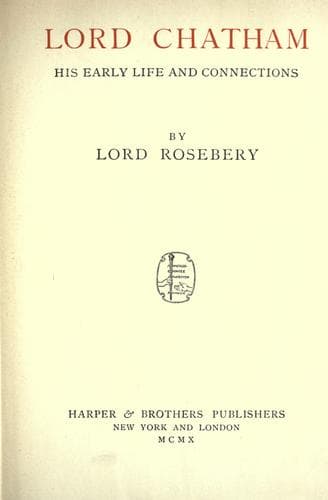
Lord Chatham, His Early Life and ConnectionsRosebery, Archibald Philip Primrose, Earl of
History
Lord Chatham, His Early Life and Connections
Rosebery, Archibald Philip Primrose, Earl of
Pitt, William, Earl of Chatham, 1708-1778
Bath kissed hands as First Minister, and received the seals of the
Secretaries of State to transmit to Carteret, who was ill. The new
Secretary at once announced by circular his appointment to the foreign
ministers. But there all ended. When old Horace Walpole was told that
this ministry was settled he shrewdly remarked: 'I presume in the same
manner as what we call a settlement in Norfolk; when a house is cracked
from top to bottom and ready to fall, we say it is settled.'[174]
Winnington was to have been the new Chancellor of the Exchequer. Thrice
did the King press the seal into his hand, and thrice did Winnington
return it. 'Your new ministers, sir, can neither support Your Majesty
nor themselves,' said he.[175] He insisted, moreover, that they could
not depend on more than 31 peers and 80 commoners. History does not
confirm even so moderate a computation, but it may be presumed that this
was the Court contingent on which any minister could count.
Harrington, one of the actual Secretaries of State, on whom the King
confidently reckoned for assistance in the new arrangement, resigned,
after a stormy scene with his master, who never forgave him. Every one
resigned or tried to resign, and there was no one to fill their places.
To Pelham himself Carteret had made overtures; but Pelham told the King
that the Whig junto would have nothing to do with Bath or Carteret. At
last, the only measure left to the hapless monarch was to shut himself
up and forbid his door to the crowd that sought admittance in order to
give up their keys and staves and official insignia. He was soon
compelled to send for Bath and to tell him that it would not do. Bath
exhorted him to be firm, and offered by means of the Prince of Wales to
secure Tory support. But with Charles Edward still in arms in the
Highlands, the King could not bring himself to approach the foes of his
house, and under no circumstances would he owe salvation to his son.
Both Princes of Wales, the real and the titular, were almost equally
repugnant to him. Another version of the story states that it was Bath
who told the King that the project would not work. It matters little
which is correct, for the position was self-evident, but George was
probably stouter than Bath.
Public-domain text, read in full here on John Shaqi.
Reviews
Reviews
No reviews yet
Be the first to share your thoughts on this work.
Elsewhere in the archive
Join the Discussion
Join the discussion
Sign in to leave a comment or review.
Sign InorCreate an account