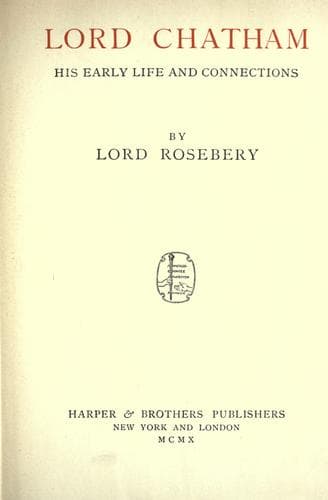
Lord Chatham, His Early Life and ConnectionsRosebery, Archibald Philip Primrose, Earl of
History
Lord Chatham, His Early Life and Connections
Rosebery, Archibald Philip Primrose, Earl of
Pitt, William, Earl of Chatham, 1708-1778
Bath kissed hands on February 10 (1746). Two days afterwards his
ministry had come to an end, and the King had sent for Pelham to return.
Carteret saw the humour of the situation and laughed it away; he owned
it a mad escapade, but was all the more ready to repeat it. It was all
over, the King had to surrender to the Whigs, who condescended to resume
the seals on easy terms, which were the proscription of Bath's following
and the admission of Pitt. The first condition was simple enough, it was
the natural result of Bath's defeat. _Vae victis._ 'We immediately
desired,' writes Newcastle, 'that the Court might be purged of all their
friends and dependents, that Lord Bath might be out of the Cabinet
Council, the Duke of Bolton, Lord Berkeley of Stratton, Mr. William
Finch, the Vice-Chamberlain, Mr. Edward Finch, the Groom of the
Bedchamber, Mr. Boone, and the Lord Advocate of Scotland (which were all
that were left of that sort), should be removed.' We have an impression
that, in spite of all, 'the black, funereal Finches' were preserved to
the Bedchamber and to the card table, but that does not concern this
narrative.
As to the second condition, it was inevitable sooner or later, and took
place in the form least offensive to the Sovereign. But the ministerial
crisis and the desperate venture with Bath and Carteret testify to the
formidable position of Pitt and to the equal aversion of the Sovereign.
In no less an instance than Pitt's could this repulsion have been
overcome.
Pitt himself had begged that his pretensions to the Secretaryship at War
should not act as an obstacle to an accommodation with the King, for
there was evidently nothing so repugnant to the Sovereign. The King had
said first that he would not have him in that office at any price, then
that he would use him ill if he had it, then that he would not admit him
to his presence to do the business of the office if he had it.[176]
There is, if the matter be candidly considered, no just cause of
reproach in this obstinacy. George II. was a gentleman, and a brave
gentleman. The Hanoverians were his own people, of his own blood and
language. Hanover was the home in which he had been brought up, the
paradise to which he always looked longingly from his splendid exile in
England. The King's personal courage Pitt had publicly and wantonly
aspersed; Hanover and the Hanoverians he had held up to every form of
public hatred and contempt. One cannot be surprised that George II.
would have nothing to say to him except under compulsion, and refused,
as between one gentleman and another, to have personal relations with
him. As a constitutional ruler his duty was another matter, but he would
not perform a duty so odious except in the last resort. He ignored Pitt
even after Pitt had entered office. It was four years after Pitt became
Paymaster that Newcastle, as the result of long pressure or intrigue,
induced the King even to speak to him. This was considered a triumph for
the ministry.[177]
Public-domain text, read in full here on John Shaqi.
Reviews
Reviews
No reviews yet
Be the first to share your thoughts on this work.
Elsewhere in the archive
Join the Discussion
Join the discussion
Sign in to leave a comment or review.
Sign InorCreate an account