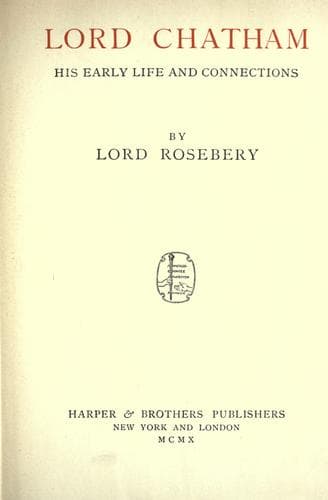
Lord Chatham, His Early Life and ConnectionsRosebery, Archibald Philip Primrose, Earl of
History
Lord Chatham, His Early Life and Connections
Rosebery, Archibald Philip Primrose, Earl of
Pitt, William, Earl of Chatham, 1708-1778
Lord Camelford's statement may be taken in the main to be correct
without adopting the sour inference which he draws. Pitt may well have
asked Pelham as to the practice of the office and Pelham have replied in
the sense indicated. If so, it was nearly as creditable to Pelham as to
Pitt, for one was scarcely less needy than the other. Pelham was a
gambler, and so wanted all the money he could get. He was a politician,
and politicians in those days required money for their purposes almost
as much as gamblers. Lord Camelford implies that had Pelham not answered
as he did, Pitt would have taken the percentages and the balances. This
is mere surmise. But, had he done so, he could not have been blamed.
These perquisites were regarded as legitimate by the practice and
opinion of the day; the balances were matters of public account. They
made the Paymaster's office a great prize, a recognised source of
immense profits. The fact remains that Pitt, or Pitt and Pelham, thought
them improper, and refused to take them.
One signal difference must however be observed. Pelham abstained
silently, the abstinence of Pitt was widely known. This notoriety may
have been partly due to the fact that the King of Sardinia, having heard
of Pitt's refusal to deduct the percentage on the Sardinian subsidy,
sent to offer him a large present, which Pitt unhesitatingly declined.
But there was another reason, which colours Pitt's whole life, and which
may therefore well be noted here. His light was never hid under any sort
of bushel, and he did not intend that it should be. He already saw that
his power lay with the people, and that it was based not merely on his
genius and eloquence, but on a faith in his public spirit and scrupulous
integrity. His virtues were his credentials, and it was necessary that
they should be conspicuous. Pulteney and St. John had wielded greater
Parliamentary power, yet Pulteney and St. John had perished from want of
character. Character he saw was the one necessary thing, but character
must be known to be appreciated. Pitt was perhaps the first of those
statesmen who sedulously imbue the public with a knowledge of their
merit. He can scarcely be called an advertiser, but he was the ancestor
of advertisers. Other statesmen no doubt had paid their pamphleteers.
Pitt paid nobody, but he inspired; he had hangers-on who clung to the
skirts of his growing fortune. This is not to imply that he had not a
genuine scorn of meanness and corruption and the baser arts of
politics. He had to use them through others; he had to ally himself with
Newcastle and his gang; he could not govern otherwise. But he was
anxious that the public should know that he was something apart from and
above these politicians. His was a real but not a retiring purity; a
white column rather than a snowdrop. This was all part of his
essentially theatrical character, which he had found successful in
Parliament, and which gradually absorbed him, with unhappy results.
Public-domain text, read in full here on John Shaqi.
Reviews
Reviews
No reviews yet
Be the first to share your thoughts on this work.
Elsewhere in the archive
Join the Discussion
Join the discussion
Sign in to leave a comment or review.
Sign InorCreate an account