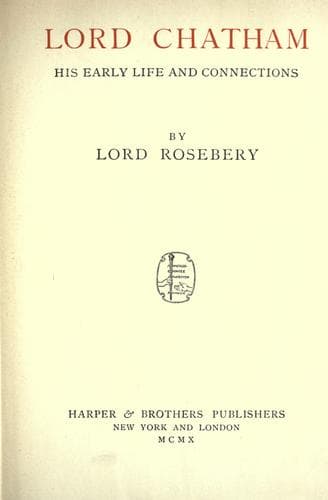
Lord Chatham, His Early Life and ConnectionsRosebery, Archibald Philip Primrose, Earl of
History
Lord Chatham, His Early Life and Connections
Rosebery, Archibald Philip Primrose, Earl of
Pitt, William, Earl of Chatham, 1708-1778
But there was another reason why it was necessary that Pitt should
advertise his virtue on this occasion. He was a patriot joining the
Court party, a member of the Opposition accepting a place, which, with
all deductions, had a fixed and ample salary. It was not possible for
him, though his friends were already established in office, to join them
without some loss of popularity. It was difficult for him to keep his
shield untarnished in the royal armoury. The morose Glover states that
he brought himself to the level of Lord Bath in public disfavour by his
acceptance of office. Pitt himself, at the time of his bitter
mortification in 1754, writes to Lord Hardwicke of his 'bearing long a
load of obloquy for supporting the King's measures,' without the
smallest abatement of the King's hostility, and about the same time
describes himself as having parted with that weight in the country which
arose from his independent opposition to the measures of the Government.
He must indeed have counted the cost. It seemed obvious and in the
nature of things that Lytteltons, Grenvilles, and Cobhams should follow
the other patriots into office when opportunity offered; they had no
doubt barked loudly at ministers, but they belonged to the families
which always governed the country, and it was proper, indeed inevitable,
that they should take up their predestined positions on the Treasury
Bench. But Pitt had stood on a different pedestal. He had been marked
out by Walpole for punishment and by the King for exclusion. He had
thundered against the King and the King's trusted Ministers, the
Walpoles and the Carterets, with a voice that overbore all others, and
which apparently could not be silenced. The people seemed at last to
have found an incorruptible champion. Then suddenly he was muzzled with
a sinecure. Had he insisted on the Secretaryship of War and wrenched it
from the reluctant sovereign, the position would have been totally
different. But to pass into the sleek silence of the Vice Treasurership,
and almost to disappear from sight or hearing for eight years, seemed a
moral collapse. It is not one of the least remarkable features of Pitt's
career that he should have survived this lucrative obscurity.
Public-domain text, read in full here on John Shaqi.
Reviews
Reviews
No reviews yet
Be the first to share your thoughts on this work.
Elsewhere in the archive
Join the Discussion
Join the discussion
Sign in to leave a comment or review.
Sign InorCreate an account