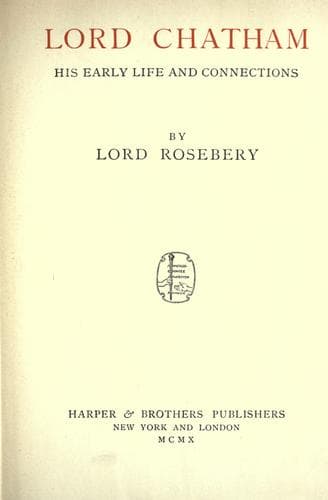
Lord Chatham, His Early Life and ConnectionsRosebery, Archibald Philip Primrose, Earl of
History
Lord Chatham, His Early Life and Connections
Rosebery, Archibald Philip Primrose, Earl of
Pitt, William, Earl of Chatham, 1708-1778
could not have kept out of it. Bright, his illustrious political twin,
the Castor to his Pollux, took it and liked it. In the eighteenth
century we can think of no one but Pulteney. He, indeed, strictly
speaking, is no exception, for as a youth he held a subordinate post.
And though in the maturity of his powers he refused the first place when
apparently he might have had it, he also solicited it when it was out of
his reach.
Althorp too, in the last century, is a singular example. He led the
House of Commons for four years as Chancellor of the Exchequer, when his
popularity and ascendancy made him the real pivot of the Government. But
he hated office with so deadly a hatred that he had the pistols removed
from his room lest he should end his official career with them. He
really comes in the list of exceptions to the rule that office is the
goal of all capable politicians.
But Pitt had nothing in common with these men. He wished to be in
office, and he knew that he would be a better minister than any there,
even though he may not have felt already the confidence which he
afterwards expressed that he alone could save England. How then was he
to obtain a foothold in the ministry? The just repugance of the King
was, he knew, insurmountable, so long as he remained outside. But if
admitted to office he might well hope much from his power of
fascination, which was almost famous. The King was not an easy person
for any man to charm; but Pitt no doubt felt that if he could once be
placed in contact with His Majesty, he might be able to remove the royal
prejudice; though in that he seems to have been wrong. He tried his hand
on Lady Yarmouth, with whom at a later period he seems to have been on a
familiar footing; but it is doubtful if she ever dispelled, though she
may have mitigated, the King's hatred of Pitt.
Even failing the mollification of the King, he felt that by taking
office he would have entered the official caste, and he would have
placed his foot on one rung of the ladder of greatness. In accepting the
Vice-Treasurership he had doubtless been promised the next post that was
vacant, and was, as has been seen, given the Paymastership. He was thus
reunited to all his political friends, and would form with them a solid
proportion of the garrison of Downing Street, a proportion to be
reckoned with. It would be strange indeed if in such a position and with
such feeble superiors he did not make his way to some position of real
business and power.
Public-domain text, read in full here on John Shaqi.
Reviews
Reviews
No reviews yet
Be the first to share your thoughts on this work.
Elsewhere in the archive
Join the Discussion
Join the discussion
Sign in to leave a comment or review.
Sign InorCreate an account