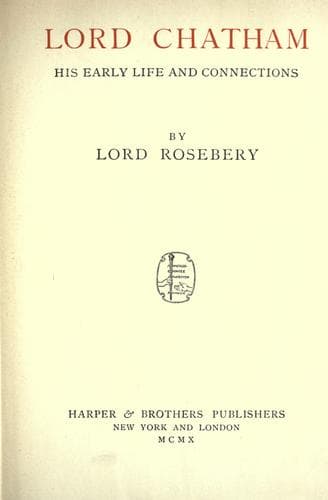
Lord Chatham, His Early Life and ConnectionsRosebery, Archibald Philip Primrose, Earl of
History
Lord Chatham, His Early Life and Connections
Rosebery, Archibald Philip Primrose, Earl of
Pitt, William, Earl of Chatham, 1708-1778
It is indeed difficult to understand how so fierce and restless a spirit
could have endured the passive existence to which he had restrained
himself by the acceptance of office. We seem to hear a growl but a few
months after he had become Paymaster. 'In the gloomy scene which, I
fear, is opening in public affairs for this disgraced country,' he
writes to George Grenville in October 1746; not a cheerful tone for a
young minister, but one not unfamiliar among those in subordinate
positions. Still he could afford to wait. He probably contented himself
with the reflection that King George could not last for ever, and
flattered himself with an easy entrance to the councils of King
Frederick. He could watch, too, with silent scorn, the miscarriages of
his official superiors, confident that high office must come to him, as
it were, of its own accord. Still, he had to wait long, and the death of
Frederick as well as the longevity of the monarch were little less than
disastrous to his calculations. It would have been better, of course,
for his historical position had he refrained from taking a subordinate
office, which restrained his independence, and deprived him of the
peculiar lustre of his lonely power. In these days we ask ourselves what
temptation could induce him to accept a post which seemed to offer
nothing but salary in exchange for the exceptional splendour of his
independent position? How was it worth his while to become
Vice-Treasurer of Ireland? It cannot have been for money. He was
notoriously indifferent to money (though his nephew casts doubts even on
this), and he was better off as to money than he had ever been before,
owing to the Marlborough legacy. It may have been that as his political
associates had all joined the administration, he thought that his
loneliness impaired his power, and he must certainly have felt that it
was impossible for him to continue in active and effective opposition to
a Government which included his closest friends. That would seem to be
the chief and conspicuous reason. But there was another, as one may well
suppose, which was not less potent. Office is the natural, legitimate
and honourable object of all politicians who feel capable of doing good
work as ministers, and even of some who do not. The instances to the
contrary are so few as to prove the rule. Wilberforce and Burdett,
Ashley (for Ashley, though not literally outside the category of
officials, cannot be considered as one), and Cobden are the names that
obviously present themselves. But Ashley and Wilberforce had
consecrated themselves to a high career of philanthropy which was
incompatible with the bond of ministry. Burdett, long a popular idol and
an orator of great power, a country gentleman of the best type, and
personally agreeable even to those who differed from him, was probably
held to be too advanced a demagogue to be even considered for an
appointment. Cobden refused office at least twice; yet had he lived he
Public-domain text, read in full here on John Shaqi.
Reviews
Reviews
No reviews yet
Be the first to share your thoughts on this work.
Elsewhere in the archive
Join the Discussion
Join the discussion
Sign in to leave a comment or review.
Sign InorCreate an account