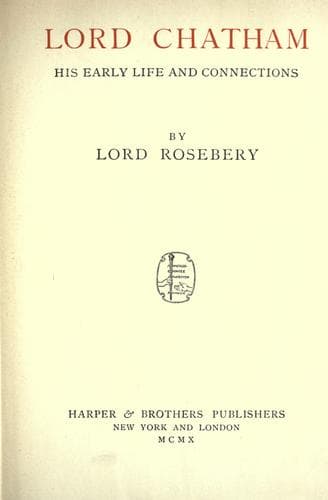
Lord Chatham, His Early Life and ConnectionsRosebery, Archibald Philip Primrose, Earl of
History
Lord Chatham, His Early Life and Connections
Rosebery, Archibald Philip Primrose, Earl of
Pitt, William, Earl of Chatham, 1708-1778
This consideration leads us to what is the best, and probably the true,
explanation of this voluntary eclipse: that in taking office he was
taking leave of his youth and of his past, and embarking on a new phase
of his career. Up to this time he had, like a predatory animal, lived
wholly on attack, and had given no thought to consistency, and little to
his future. He had only been a rattling politician, determined to make
his way, thinking only of the game, and of how to develop and display
his powers of oratory. He had been content to adopt Cobham's enemies as
his own, and had tried on them the temper of his virgin sword, without
much caring who they were or why he attacked them, so long as they were
sufficiently prominent to give notoriety to their assailant. His course
had been one of brilliant recklessness and of striking eloquence; but at
bottom it had been nothing but faction. There have been many such
swashbucklers in our history, and there will be many more. But it is
rare that, as in Pitt's case, they develop into something supreme. With
Pitt these extravagancies had only been the frolics of genius. By
burying himself in the sedateness and reticence of office, Pitt sought
to break with his dazzling indiscretions, and mature himself for
statesmanship. He retired behind a screen in order to change his dress.
That, one may infer, was his design; that, certainly, was the effect.
To make an end of this topic, one may ask why Pitt, so fertile of
invective himself, was not the subject of execration when he joined the
Court. Great men no doubt may commit faults, even crimes, with impunity,
for the lustre of their achievements throws a shadow over their errors.
In such men it is recognised that all is usually on a colossal scale,
deeds and misdeeds alike. As they are capable of gigantic successes,
they are also capable of stupendous blunders. This is true of Pitt's
whole career, but it does not explain the facility with which he was now
able, before he had his famous administration to his credit, to subside
into an easy placeman and vindicate the measures which he had previously
denounced. A few lampoons were of course launched at so tempting an
object, but he was not made a conspicuous butt. Nor does he seem to have
lost, or if he did he soon regained, the ear and confidence of the
people. He had at all periods rare powers of recovery. But in this case
the fact is not difficult to explain. In the first place it must be
borne in mind that what he did was the ordinary thing to do. Again, his
personal friends, and even those who had intercourse with him, were
impressed by his character and believed in his integrity. Then the
refusal of the indirect profits counted for much, it gave an air of
austere virtue to a proceeding otherwise questionable. Again, there was
no particular object to be gained by attacking him. Who indeed was there
to attack him? No one thought it worth their while to subsidise Grub
Public-domain text, read in full here on John Shaqi.
Reviews
Reviews
No reviews yet
Be the first to share your thoughts on this work.
Elsewhere in the archive
Join the Discussion
Join the discussion
Sign in to leave a comment or review.
Sign InorCreate an account