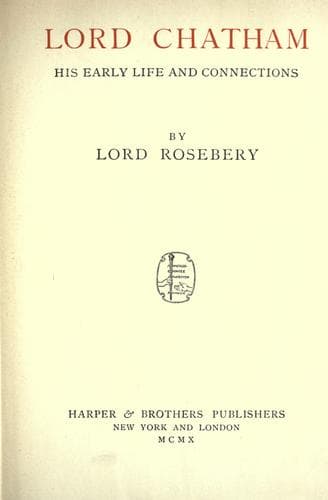
Lord Chatham, His Early Life and ConnectionsRosebery, Archibald Philip Primrose, Earl of
History
Lord Chatham, His Early Life and Connections
Rosebery, Archibald Philip Primrose, Earl of
Pitt, William, Earl of Chatham, 1708-1778
Street for the purpose of throwing dirt on a silent Paymaster, and few
dared attack him to his face. He had already inspired the House of
Commons with that awe of him which subsisted and increased so long as he
remained there. To deliver a philippic against Pitt was no joking
matter; it required a man with iron nerves who was reckless of
retribution. Lee, as we have seen, had attempted one, but, in spite of
Horace Walpole's eulogy, he does not seem to have repeated the
experiment. Hampden also attacked him, as we shall see, in terms which
would have led to a duel had not the Speaker interposed his authority.
Fox and Grenville withstood him doggedly in after years. Barré, when an
obscure Irish adventurer, tried an attack not altogether without
success, but did not care to renew the attempt, and became, in fact,
Pitt's devoted follower. But these instances must be considered as
singularly rare when it is remembered how tempting a mark was presented
by Pitt's career, how frank and direct was the language of Parliament,
and how generous the potations which flushed its debates. Murray, Pitt's
contemporary and his equal in sheer ability, cowered before him; cowered
with loathing, but cowered.[181] Pitt was already surrounded, and as
years went on completely encompassed, with an armour and atmosphere of
terror which rendered him almost impregnable to personal collisions
throughout his career in the House of Commons. Some who had nothing to
lose and everything to gain baited him from time to time, but they were
always tossed back with damage. Such persistent assailants as he had,
and they only appeared in force long afterwards, were mainly anonymous.
Whatever the cause may have been, Pitt, from his accession to office in
1746, remains in obscurity and almost in silence (so far as the records
testify, though it is evident that these are extremely imperfect) for
eight long years, at the potent period of life which ranges from
thirty-eight to forty-six, the age at which Napoleon closed his career,
but which was yet two years earlier than the commencement of Pitt's.
During this long eclipse of ambition and stormy vigour he gives but few
signs of life for the most diligent chronicler to note. But he had no
sooner been appointed Paymaster than an incident took place which seemed
to point to a sudden dawn of royal favour. The Duke of Cumberland's
achievements in Scotland were to be rewarded by a pension of 40,000_l._
a year, and the King expressed a wish that the motion to this effect
should be made by Pitt. It is, however, evident that this was not a mark
of royal affection, but rather of a royal desire to utilise the new
acquisition to the Government, and in a way so little congenial as to
make Pitt feel the collar on his neck. The King may have wished to
display his captive in chains. But Cumberland, who did not love Pitt,
declined this mark of regard, and Pelham fulfilled the honorary duty.
Public-domain text, read in full here on John Shaqi.
Reviews
Reviews
No reviews yet
Be the first to share your thoughts on this work.
Elsewhere in the archive
Join the Discussion
Join the discussion
Sign in to leave a comment or review.
Sign InorCreate an account