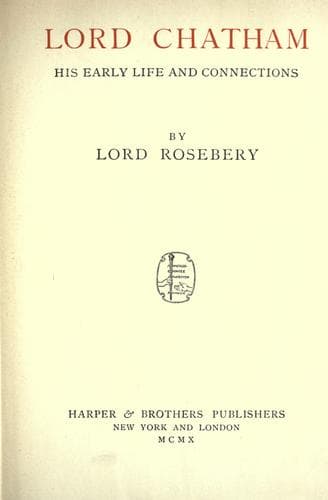
Lord Chatham, His Early Life and ConnectionsRosebery, Archibald Philip Primrose, Earl of
History
Lord Chatham, His Early Life and Connections
Rosebery, Archibald Philip Primrose, Earl of
Pitt, William, Earl of Chatham, 1708-1778
arbitrary interference of the same too powerful subject in a
parliamentary election that Pitt was now screening with jesting scorn.
But Pitt thought little of consistency, and he might well have forgotten
for the moment his earlier performance, when seeing and seizing the
opportunity for a speech which placed him on a moral elevation above the
House of Commons.
In 1748 we find him intervening comically enough in an affair,
suspiciously like a local job, which affected his friends, the
Grenvilles, and which proved the bitter and jealous animosity with which
they were regarded.
Hitherto the summer assizes for Buckinghamshire had been held at
Buckingham, and the winter at Aylesbury; but suddenly the summer assizes
had also been transferred to Aylesbury. The reason seems to have been
simple enough; for the gaol being at Aylesbury, prisoners had to be
transferred thence and back again when the assizes were at Buckingham.
Richard Grenville (afterwards Lord Temple), however, for obvious
reasons, took up the cudgels for Buckingham, which was the close
neighbour and borough of Stowe, and brought in a Bill to enact that the
summer assizes should be held at that town. All Bucks rushed into the
conflict, and as is generally the case in a local affair, the debate was
extraordinarily diverting. Richard Grenville, Sir William Stanhope of
Eythrope, the brother of Chesterfield, and afterwards a brother of the
famous or infamous Medmenham fraternity, Potter again, who had now
become secretary to the Prince of Wales, who was soon to be member for
Aylesbury, probably for his services on this occasion, and also a future
monk of Medmenham, George Grenville, the solemn figure of Pitt, Robert
Nugent (whose daughter married George Grenville's son), Lee of Hartwell,
were all visible and ardent in the thick of the battle. Henry Fox, then
a friend of Pitt, was the only outside member who intervened, and then
with a sort of puzzled surprise at the fury of the combatants. Sir
William Stanhope, who led the attack on Buckingham, made a speech which
was specially piquant. He began: 'Sir, if I did not think I could prove
that this Bill is the arrantest job that ever was brought to Parliament,
I should not give the House the trouble of hearing me.' He attributed
the Bill to the fact that the County of Bucks had not elected two
Grenvilles as their members. 'Here let me condole with that unhappy,
rather that blinded, county who neglected to choose two gentlemen of
such power and interest that I am persuaded they will have more votes
in this House to-day than they would have had at the General Election in
the whole county in question if they had done it the honour to offer
themselves for representatives.' After this bitter exordium he
proceeded: 'It is the power and interest of these gentlemen that I am
afraid of, not of their arguments;' with good reason, for though to
posterity the claim of Aylesbury with its gaol will seem conclusive, the
Bill was triumphantly carried.
Public-domain text, read in full here on John Shaqi.
Reviews
Reviews
No reviews yet
Be the first to share your thoughts on this work.
Elsewhere in the archive
Join the Discussion
Join the discussion
Sign in to leave a comment or review.
Sign InorCreate an account