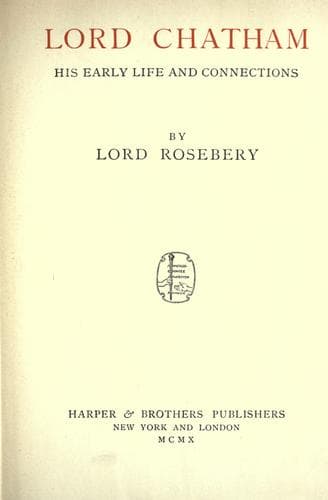
Lord Chatham, His Early Life and ConnectionsRosebery, Archibald Philip Primrose, Earl of
History
Lord Chatham, His Early Life and Connections
Rosebery, Archibald Philip Primrose, Earl of
Pitt, William, Earl of Chatham, 1708-1778
Cumberland had earned this grant, as well as his name of 'the Butcher,'
by his victory at Culloden, and the barbarity with which he had followed
up his success. Fortunately for him, it never occurred to a grateful
country to draw up a debtor and creditor account as between the nation
and the Duke. Had it done so, there would have been no grant; for his
defeats, both in number and in importance, represented something much
more considerable than this easy and solitary triumph, which would have
been amply compensated by Swift's 'frankincense and earthern pots to
burn it in' at 4_l._ 10_s._, with 'a bull for sacrifice' at 8_l._
However, mingling vengeance with gratitude, Parliament now plunged
itself with zest into the horrors of the trials of some adventurous or
bankrupt gentlemen who had followed Charles Edward, so that Pitt, even
had he so desired, had no opportunity of breaking silence. No speech of
his is recorded, indeed, till 1748.
[Sidenote: Nov. 20, 1747.]
In the meantime he had been compelled to exchange Old Sarum for the
ministerial borough of Seaford, one of the Cinque Ports; for Old Sarum
was no longer tenable. The lord of Old Sarum, his brother Thomas, was a
liege servant of the Prince of Wales, who was now once more in violent
opposition, and who indeed ran two candidates, Lord Middlesex, a member
of his household, and Mr. Gage, the sitting member, at Seaford in
opposition to the ministerial men, William Pitt and William Hay. This
proceeding sufficiently indicates the violence and completeness of the
rupture between Pitt and his former master, brought about by acceptance
of office. So tense indeed was the contest that Newcastle posted down to
Seaford in person, held a levee of the voters whom he wooed with copious
solicitation and refreshment, and during the poll sat by the returning
officer to overawe the corrupt and limited constituency. He was
victorious; Lord Middlesex exchanging seats with Pitt, for after this
his defeat he was brought in by Thomas Pitt for Old Sarum. Newcastle's
proceedings furnished matter for a petition to the House of Commons.
This Pitt treated with contempt and 'turned into a mere jest,'[182] but
Potter, son of the Primate, a clever scapegrace, of whom we shall hear
again, spoke vigorously in support of the petition. This, however, had
little chance against the argument of a compact parliamentary majority,
which rejected it by 247 to 96. But it is strange to find Pitt treating
purity of election with ridicule: all the more strange when we remember
that seven years afterwards he delivered one of his most famous speeches
in awful rebuke of the same levity on the same subject. 'Was the dignity
of the House of Commons on so sure foundations that they might venture
themselves to shake it by jokes on electoral bribery?' It was thus that
the House might dwindle into a little assembly serving only 'to register
the arbitrary edicts of one too powerful a subject.' It was the
Public-domain text, read in full here on John Shaqi.
Reviews
Reviews
No reviews yet
Be the first to share your thoughts on this work.
Elsewhere in the archive
Join the Discussion
Join the discussion
Sign in to leave a comment or review.
Sign InorCreate an account