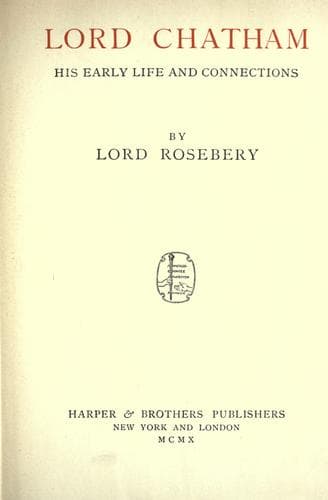
Lord Chatham, His Early Life and ConnectionsRosebery, Archibald Philip Primrose, Earl of
History
Lord Chatham, His Early Life and Connections
Rosebery, Archibald Philip Primrose, Earl of
Pitt, William, Earl of Chatham, 1708-1778
On this occasion the trouble arose over Bedford. Bedford had become
Joint Secretary of State with Newcastle on the resignation of
Chesterfield. Sandwich, a clever scapegrace, and Bedford's henchman, had
been Newcastle's candidate for the office, while Henry Fox had been
strongly supported by Pitt and others. Before offering it to Sandwich,
it was thought well to make an honorary tender of the post to Bedford,
in the belief that he would refuse it. Bedford, as sometimes happens on
such occasions, had promptly accepted it; for six months as he said,
but, as also happens, for as long as he could keep it, which was more
than three years. The appointment was thus distasteful in its origin to
Newcastle and became more irksome with experience. Bedford as a minister
was indolent, and as a man was obstinate and unamiable to a singular
degree. But it was not these drawbacks which attracted the malevolent
attention of Newcastle. Bedford, no doubt, was difficult to work with,
and Newcastle soon wished to be rid of him. But it was when Bedford
became well with the Court, with the King and with Princess Amelia, for
whom Newcastle had once affected to feel something more tender than
friendship, with the Duke of Cumberland and Lady Yarmouth, that
Newcastle's hatred passed the bounds of moderation and almost of sanity.
Pelham, who knew the parliamentary power of Bedford and who was anxious
not to alienate it, was reluctant to take up his brother's dispute; so
Newcastle promptly quarrelled with him. Pitt intervened. Had he been
blindly ambitious, he would have welcomed a schism which might have
produced a much greater position for himself. But he saw that a quarrel
between the brethren would break up the Ministry; and that such a
destruction would involve grave consequences, difficult to calculate,
and possibly the resuscitation of Carteret in the first place. Moreover,
though on the whole he sided with Newcastle, as Fox sided with Pelham,
he could not but be aware of the priceless merits of Pelham as a party
manager, as one who allayed animosities, and as one who kept the peace.
Pelham, in writing to Newcastle, affects to diminish the value of Pitt's
intervention, as he wishes to attribute the renewal of harmony to
'natural affection.' But an impartial judgment comes to a different
conclusion. Natural affection had not prevented discord, and was
insufficient to produce reconciliation. It is at all times an
indifferent political cement. But the exertions of an independent
colleague such as Pitt could not be overestimated. There exists a long
and earnest letter of July 13, 1750, from Pitt to Newcastle, too long
and too tedious to quote, but which is both tactful and energetic,
though in his worst style of winding verbosity. 'I don't hazard much,'
he wrote, 'in venturing to prophesy that two brothers who love one
another, and two ministers essentially necessary to each other, will
never suffer themselves to be divided further than the nearest friends
Public-domain text, read in full here on John Shaqi.
Reviews
Reviews
No reviews yet
Be the first to share your thoughts on this work.
Elsewhere in the archive
Join the Discussion
Join the discussion
Sign in to leave a comment or review.
Sign InorCreate an account