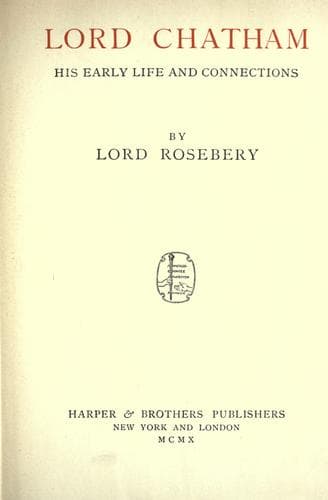
Lord Chatham, His Early Life and ConnectionsRosebery, Archibald Philip Primrose, Earl of
History
Lord Chatham, His Early Life and Connections
Rosebery, Archibald Philip Primrose, Earl of
Pitt, William, Earl of Chatham, 1708-1778
by difference of opinion or even little ruffles of temper may
occasionally be. Give me leave,' he continues, 'to suggest a doubt. May
not frequent reproaches upon one subject gall and irritate a mind not
conscious, intentionally at least, of giving cause?' and so forth.[191]
He concludes all this with warm eulogies on Newcastle's conduct of
foreign affairs, and soothes and flatters the fretful duke with
something like sympathetic regard. He or 'natural affection' is
successful, for, a week afterwards, he writes a brief note on
another subject, which ends thus: 'I am glad to note that the
understanding between you and Mr. Pelham, for which I had fears, is
re-established.'[192] It is pleasant thus to catch a glimpse of Pitt as
a loyal colleague, strenuously patching up differences; not less
pleasant to see him pushing the claims of his rival, Fox, to be
Secretary of State. This is a new human, and attractive aspect.
The termination of the Bedford transaction is worth noticing for more
reasons than one. The King, though he was at least indifferent to
Bedford, declined to remove him at the instance of Newcastle, and was
probably pleased to have the opportunity of thwarting the tiresome
minister who had been the inseparable bane and necessity of his life.
Pelham would not intervene directly for other reasons. A characteristic
and tortuous method was therefore adopted. The King cared nothing for
Sandwich, who was necessary to Bedford. So the brothers suggested the
removal of Sandwich, to which the King promptly acceded, and Bedford, as
they had foreseen, instantly resigned.
Two points are notable with regard to the vacancy thus caused. The Prime
Minister announced that the nomination of Bedford's successor must be
left to the sole nomination of the King, with which he would not
interfere in any way, but insisted that he must be a peer.[193] The main
reason for this strange limitation seems to have been that there were
fierce but dormant rivalries in the House of Commons, and that an
appointment of one of the aspirants would call uncontrollable passions
into activity. Both Secretaries of State must therefore be peers, a
principle which seems strange to a later generation. The King,
therefore, nominated Lord Holdernesse, of whom the Prime Minister merely
observes, 'I cannot possibly see him in the light of Secretary of
State.'[194] Holdernesse however is appointed, and reappears more than
once in this accidental character.
Public-domain text, read in full here on John Shaqi.
Reviews
Reviews
No reviews yet
Be the first to share your thoughts on this work.
Elsewhere in the archive
Join the Discussion
Join the discussion
Sign in to leave a comment or review.
Sign InorCreate an account