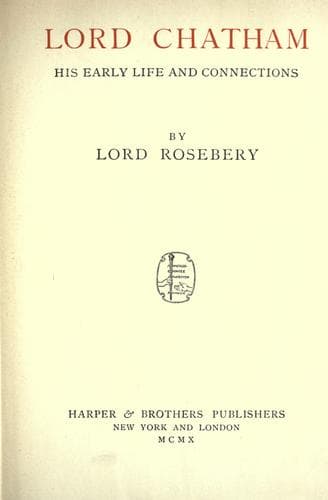
Lord Chatham, His Early Life and ConnectionsRosebery, Archibald Philip Primrose, Earl of
History
Lord Chatham, His Early Life and Connections
Rosebery, Archibald Philip Primrose, Earl of
Pitt, William, Earl of Chatham, 1708-1778
grant subsidies to foreign princes for keeping up a number of troops for
the service of the common cause of Europe, than by keeping up such
numerous armies of our own here at home, as might be of the most
dangerous consequence to our constitution.'[197] This must have seemed
strange doctrine to those who remembered his former harangues. But in
this speech he was to exceed himself in superfluous candour. He had said
that there was a good prospect of a firm and lasting peace, and then
strangely wandered off to the consequent prospect of economy at home,
'perhaps by a different method of collecting the revenue. I am not
afraid to mention the word Excise.[198] I was not in the House when the
famous Excise scheme was brought upon the carpet. If I had I should
probably have been induced by the general but groundless clamour to have
joined with those who opposed it. But I have seen so much of the deceit
of popular clamours, and the artful surmises upon which they are
founded, and I am so fully convinced of the benefits we should reap by
preventing all sorts of unfair trade, that if ever any such scheme be
again offered whilst I have a seat in this assembly, I believe I shall
be as heartily for it as I am for the motion now under our
consideration.'[199]
It is scarcely possible to conceive a more deliberate and scornful
repudiation of responsibility for any previous opinions that he may have
maintained than is expressed in this passage. He goes out of his way to
tender an unnecessary support to the detested Excise scheme, which at
the same time he declares that he should certainly have opposed had he
been in the House when it was introduced. The middle-aged Pitt seemed
never to tire of trampling savagely on the young Pitt, even wantonly, as
on this occasion. There is, indeed, more justice than is usual in Horace
Walpole's taunts when he says of Pitt, 'Where he chiefly shone was in
exposing his own conduct; having waded through the most notorious
apostasy in politics, he treated it with an impudent confidence that
made all reflections upon him poor and spiritless when worded by any
other men.' This is one way of putting it. A preferable and, in our
judgment, a truer way is that Pitt deliberately chose this method of
public atonement for past recklessness, and as an avowal that he had
learned and ripened by experience. He recanted at large, so as to
obliterate every vestige of his heedless and censorious youth. It is
better for the country and for themselves that statesmen should thus do
penance than that they should continue to offer sacrifices of what they
see to be right to the somewhat egotistical pagod of their personal
consistency. Honourable consistency is necessary to retain the
confidence of the country; but there is also a dishonourable consistency
in concealing and suppressing conscientious changes of judgment.
Public-domain text, read in full here on John Shaqi.
Reviews
Reviews
No reviews yet
Be the first to share your thoughts on this work.
Elsewhere in the archive
Join the Discussion
Join the discussion
Sign in to leave a comment or review.
Sign InorCreate an account