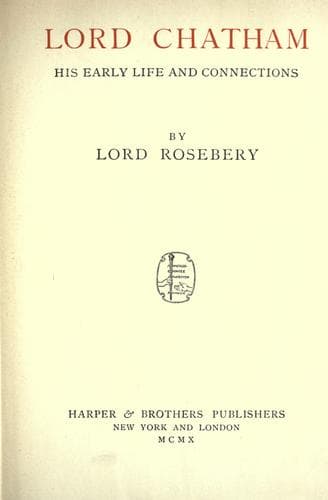
Lord Chatham, His Early Life and ConnectionsRosebery, Archibald Philip Primrose, Earl of
History
Lord Chatham, His Early Life and Connections
Rosebery, Archibald Philip Primrose, Earl of
Pitt, William, Earl of Chatham, 1708-1778
Though, as we have seen, his defence of the principle of subsidies
seemed unbounded, it was more limited in practice, and Pitt fixed his
limit at the Bavarian contribution. In 1752 Pelham had to move a subsidy
to the Elector of Saxony, King of Poland. This had been negotiated by
Newcastle, but was so strongly disapproved by Pelham that he even
threatened to second the opposition to it. However, he was persuaded by
the argument most urgent and sometimes most fatal to prime ministers,
that the apparent unity of the Government must at any cost be
maintained, to withdraw his opposition and move the vote. Old Horatio
Walpole, though he voted with Pelham, spoke warmly against him, and Pitt
supported Walpole's argument, though privately and not in speech. He
felt, it may be presumed, that it was not for him to be more of a
Pelhamite than Pelham himself.
With Pelham, however, he had felt constrained to be at open variance in
the previous year, about the time of the Bavarian subsidy. The Minister
had moved a reduction of our seamen from 10,000 to 8000. Pitt declared a
preference for 10,000; and Potter, whom we have seen in the Buckingham
and Aylesbury affair, a clever, worthless fellow, who had now become an
ally of Pitt, opposed the reduction. Pelham seemed to acquiesce, but
Lord Hartington, an enthusiastic Pelhamite, who was hereafter to be for
a while Prime Minister under Pitt, forced a division, in order to show
Pitt that the Whigs would not support him against Pelham. Pitt's
immediate following on this occasion seems to have consisted only of
Lyttelton, the three Grenvilles, Conway, and eight others. There was, it
is to be observed, nothing factious in this; the opinion of Pitt was
natural, and not distasteful to Pelham. Moreover, on the report Pitt
made a conciliatory speech, marking in the strongest manner his regret
at differing with Pelham, declaring that it was his fear of Jacobitism
alone which made him prefer the larger number, and expressing his
concern at seeing our body of trained seamen, whom he called our
standing army, reduced. He and his little following, or rather
cousinhood, vied with each other in loyal eulogies of the Prime
Minister.
This called up Hampden, an intrepid buffoon, but the great-grandson of
the patriot, and 'twenty-fourth hereditary lord of Great Hampden,' who
attacked Pitt and his group with rancour. Here, again, we seem to
discern traces of Buckinghamshire politics and jealousies. Temple and
his belongings had, as we have seen, many enemies in their own county,
and Hampden was one of them. Perhaps the Aylesbury affair still rankled.
Pitt was visibly angered. Though Pelham warmly defended him, he was not
appeased, and the affair would have ended in a duel had not the
Speaker's authority intervened. In the succeeding year, it may be noted,
the number of 10,000 was restored.
Public-domain text, read in full here on John Shaqi.
Reviews
Reviews
No reviews yet
Be the first to share your thoughts on this work.
Elsewhere in the archive
Join the Discussion
Join the discussion
Sign in to leave a comment or review.
Sign InorCreate an account