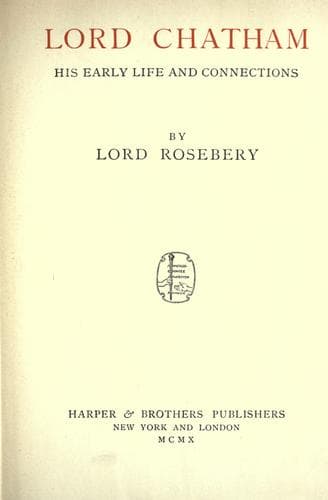
Lord Chatham, His Early Life and ConnectionsRosebery, Archibald Philip Primrose, Earl of
History
Lord Chatham, His Early Life and Connections
Rosebery, Archibald Philip Primrose, Earl of
Pitt, William, Earl of Chatham, 1708-1778
adds in a postscript a list of shrubs or trees which he recommends.
Legge's playful sarcasms as to expense did not deter his friend.
By 1752 Pitt had converted South Lodge, in the opinion of his friends or
flatterers, into a delightful pleasance. He had, in the fashion of those
days, constructed a Temple of Pan with appropriate surroundings, which
excited the admiration of critics, and is mentioned with special
admiration, we are told, 'by Mr. Whately, a forgotten expert, in his
"Observations on Modern Gardening," as one of the happiest efforts of
well-directed and appropriate decoration.' The famous blue-stocking,
Mrs. Montagu, writes of the 'shady oaks and beautiful verdure of South
Lodge.' 'There can,' she says in another letter, 'hardly be a finer
entertainment not only to the eyes, but to the mind, than so sweet and
peaceful a scene.' Yet Pitt assured her that he had never spent an
entire week there. Gilbert West paid a visit there, when suffering
presumably under an attack of the gout. 'He had provided for me a
wheeling-chair, by the help of which I was enabled to visit every
sequestered nook, dingle, and bosky bower from side to side in that
little paradise opened in the wild.'[223] So that the garden would seem
to have really been a success.
But Pitt was to prove fickle to all these charms. On leaving Tunbridge
Wells after the completion of his course of waters, he intended, besides
long visits to Stowe and Hagley, to pay a passing visit to Hayes, a
place near Bromley, of which his friend, Mrs. Montagu, had a lease.
Whether it was a case of love at first sight or not, we do not know, but
Hayes was destined to be the home of his affections and the place most
closely identified with himself. At the termination of Mrs. Montagu's
lease in 1756, he bought it of the Harrison family, who owned it, and a
letter from him is dated thence in May 1756. But in January 1765 he
inherited the Burton Pynsent estate, and so, in the following October,
he offered the Hayes property to his friend, the Hon. Thomas Walpole, at
a fair valuation, indeed at cost price. He had wasted on it, we are
told, prodigious sums, with little to show for it, for he had spent much
in purchasing contiguous houses to free himself from neighbours. 'Much
had gone in doing and undoing, and not a little portion in planting by
torchlight, as his peremptory and imperious temper could brook no
delay.' He had, moreover, Wallenstein's morbid horror of the slightest
sound. Though he doted on his children, he could not bear them under the
same roof; they were placed in a separate building communicating with
the main structure by a winding passage. Vast sums were thus expended
without adding to the value of the property. But now he was eager to
leave the cherished home which had swallowed so much of his fortune, and
to hurry to the new scene. His intention of retiring into Somersetshire
seems to have caused some alarm among his friends, who feared that it
Public-domain text, read in full here on John Shaqi.
Reviews
Reviews
No reviews yet
Be the first to share your thoughts on this work.
Elsewhere in the archive
Join the Discussion
Join the discussion
Sign in to leave a comment or review.
Sign InorCreate an account