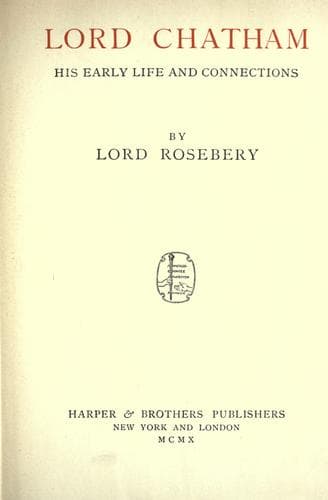
Lord Chatham, His Early Life and ConnectionsRosebery, Archibald Philip Primrose, Earl of
History
Lord Chatham, His Early Life and Connections
Rosebery, Archibald Philip Primrose, Earl of
Pitt, William, Earl of Chatham, 1708-1778
betokened retirement from public life; but with little reason, for it
was in June 1766 that the sale of Hayes to Mr. Walpole was completed,
and in the succeeding month Pitt was First Minister. His accession to
power was, however, accompanied by a combined attack of all his
maladies, nervous and physical; and his morbid, violent cravings had, if
possible, to be indulged. The most imperious of these was for Hayes, and
he persuaded himself that its air was necessary to his recovery. He
negotiated through Camden with Walpole, who unfortunately, in his year
of residence, had become passionately attached to the place. But Pitt
had become frantic. Hayes could not be mentioned before him for fear of
causing immoderate excitement. 'Did he' (Pitt) 'mention Hayes?' Camden
asked James Grenville, who had just visited his illustrious
brother-in-law. 'Yes; and then his discourse grew very ferocious.' Lady
Chatham wrote imploring and pathetic letters to Walpole, who was ready
to lend indefinitely, but not to sell. It would save her husband and her
children; her children's children would pray for him. Meanwhile, even if
Walpole consented, they had no money to buy with. They determined to
sell part of the Pynsent inheritance. But that would only suffice to pay
other debts, and Hayes would have to be mortgaged as well. Nothing could
better prove the insane violence of Pitt's desire. At last, in October
1767, Walpole yielded to Pitt's importunity, and in December the great
man found himself once more at home. Camden declared of Walpole that
'the applause of the world and his own conscience will be his reward,'
but it is not altogether pleasant to find that he did not disdain much
more material compensations. Pitt had sold the house and grounds in June
1766 for 11,780_l._, and had to buy them back in November 1767 for
17,400_l._, a difference of 5628_l._; so that he had to pay a smart fine
for his caprices. The whole purchase came to 24,532_l._, but this
includes other items, and lands which had been added by Walpole.[224] In
1772 he appears again to have contemplated selling Hayes,[225] but he
was destined to die there. All this is anticipation, but follows
naturally on the topic of Pitt's country life.
CHAPTER XV.
Public-domain text, read in full here on John Shaqi.
Reviews
Reviews
No reviews yet
Be the first to share your thoughts on this work.
Elsewhere in the archive
Join the Discussion
Join the discussion
Sign in to leave a comment or review.
Sign InorCreate an account