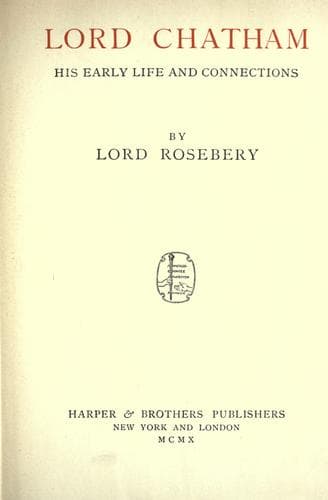
Lord Chatham, His Early Life and ConnectionsRosebery, Archibald Philip Primrose, Earl of
History
Lord Chatham, His Early Life and Connections
Rosebery, Archibald Philip Primrose, Earl of
Pitt, William, Earl of Chatham, 1708-1778
The places were now all filled: the Government was made up: Pitt was
excluded and proscribed. Fox or Murray, he admitted, might reasonably be
put over his head. But the promotion of Robinson was a personal outrage.
So he would no longer sit in Parliament as a subordinate and almost a
creature of Newcastle's, member for one of his boroughs, Paymaster in
his administration. Pitt was now determined to be free. He would remain
out of London, and they might see how they got on without him. When he
did return to London they should realise what they had lost. Meanwhile
he would occupy himself with a little architecture and a little
gardening; all that he was fit for, as he would assure inquirers with
obsequious sarcasm.
CHAPTER XVI.
In the meantime all had been settled by hasty arrangements in London.
Owing to Newcastle's 'overwhelming affliction,' Hardwicke tells us that
he himself was compelled to step forward as a 'kind of minister _ab
aratro_,' and make the necessary arrangements. A faint offer of the
Treasury was made to the Duke of Devonshire, which he wisely declined,
and, six days after the death of Pelham, Newcastle, in spite of his
overwhelming affliction, was proclaimed his successor. We do not doubt
Newcastle's sorrow, for in his own way he loved his brother and had
divided his patrimony with him; but it is even more certain that the
Chancellor acted as his watch-dog in front of the Treasury. For the
Duke, though his timidity was a standing jest, could not bear that any
one else should obtain the rich prize which he coveted and dreaded. And,
in truth, if that was his view, no one could controvert it, for his
power in the House of Commons was obvious and undeniable. The King seems
to have made no trouble. He said that he had an open mind, and would be
guided by the opinion of the Cabinet as to the nomination of their new
chief. The suggestion shocked Hardwicke. 'To poll in a Cabinet Council
for his first minister, which should only be settled in his closet, I
could by no means digest.' So Hardwicke, with remarkable expedition,
took care that the Closet, which was the term used to denote the King's
personal apartment and so his personal authority, should pronounce in
favour of Newcastle. But the Closet was guided by the Cabinet in spite
of Hardwicke's scruples; and the Cabinet, a facile caucus, inspired by
Hardwicke himself, represented to the King as its unanimous opinion that
Newcastle should be their chief. Horace Walpole tells us that it was 'to
the astonishment of all men.' To us it seems the only natural solution.
Hardwicke had declared that a peer must be placed at the head of the
Treasury. 'That peer must be somebody of great figure and credit in the
nation, in whom the Whigs will have great confidence.' He was no doubt
painting the figure to represent Newcastle. But who else could it be?
Newcastle was the head of the Whigs, the master of Parliament, Secretary
Public-domain text, read in full here on John Shaqi.
Reviews
Reviews
No reviews yet
Be the first to share your thoughts on this work.
Elsewhere in the archive
Join the Discussion
Join the discussion
Sign in to leave a comment or review.
Sign InorCreate an account