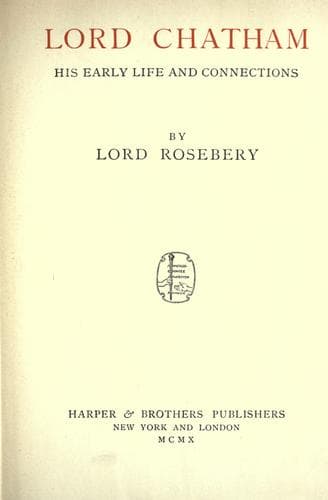
Lord Chatham, His Early Life and ConnectionsRosebery, Archibald Philip Primrose, Earl of
History
Lord Chatham, His Early Life and Connections
Rosebery, Archibald Philip Primrose, Earl of
Pitt, William, Earl of Chatham, 1708-1778
Nothing can better illustrate the extraordinary power which Newcastle
wielded in the House of Commons than the dumb terrified fidelity of the
great majority who clung to his knees in spite of the attacks of Pitt
and Fox. Hapless majority! They had neither voice nor faith; they
despised almost equally their nominal chief Robinson, and their real
chief Newcastle; so they huddled together for warmth and sympathy. And
this was a House of Commons produced by a general election carried on
under the auspices of a consummate manipulator and by long years of
cozening, patronage, and corruption. The success had been complete, a
devoted and passive majority had been returned, and this was the result.
It was a strange and instructive spectacle. This docile flock was
shepherdless, it was not thought to need any superintendence, it had
only to receive its instructions from Newcastle through the channel of
some such agent as Robinson. What Newcastle thought well to give, it was
prepared gladly to take. Could Minister want more? Yet, before the
session was a fortnight old, Newcastle was to learn, but not completely,
the futility of such a scheme of government. He had promised the King
that the new House of Commons would need no leader, that indeed the
position of leader of the House of Commons was both dangerous in power
and superfluous in practice. He was yet to learn that there was
something more formidable; a ship without captain or helmsman, and two
loose cannon banging about at large.
For, two days after the annihilation of Robinson, Pitt again took the
field, this time against Murray, the most formidable antagonist that he
ever had to face after the resignation of Walpole. It was on the vote
for the army. Barrington and Nugent had made fulsome speeches, dwelling
on the popularity of the King and the Ministry, declaring, indeed, that
there were no Jacobites in England. People, said Nugent, sometimes
reared those whom they thought would be Jacobites, but who turned out
very differently. So had he seen in his rural retirement a hen, which
had hatched duck's eggs, watch with apprehension her nurslings betake
themselves to the water. Pitt rose and declared with solemn pleasantry
that this image had greatly struck him, 'for, sir, I know of such a
hen.' The hen, it appeared, was the University of Oxford. This, we
think, in its demure unexpectedness, is the best stroke of humour in all
his speeches. But he begged the House not to be sure that all she
hatched would ever entirely forget what she had taught them. Then
followed an innuendo at old Horace Walpole which is immaterial and
obscure. Sir Roger Newdigate, whose name is still cherished by budding
poets, rose, as member for the University, to make a meek defence. Pitt
rose again, and told 'inimitably' the story of a recent adventure at
Oxford. He was with a party at the Angel Inn, one of whom was asked to
sing 'God save Great George our King' (one can hardly imagine that it
was Pitt who called for this).
Public-domain text, read in full here on John Shaqi.
Reviews
Reviews
No reviews yet
Be the first to share your thoughts on this work.
Elsewhere in the archive
Join the Discussion
Join the discussion
Sign in to leave a comment or review.
Sign InorCreate an account