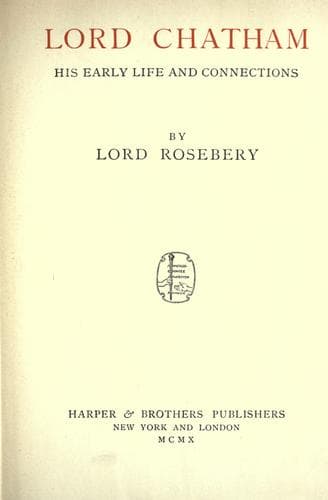
Lord Chatham, His Early Life and ConnectionsRosebery, Archibald Philip Primrose, Earl of
History
Lord Chatham, His Early Life and Connections
Rosebery, Archibald Philip Primrose, Earl of
Pitt, William, Earl of Chatham, 1708-1778
Yorke reported to his father, and Hardwicke saw Pitt on August 8 (1755),
with power to offer a seat in the Cabinet. After compliments, to use
Eastern language, which were usually the preface of such interviews, in
which both parties assured each other of high mutual esteem, which Pitt
went so far on this occasion as to declare for Newcastle, in strange
contrast with his language to Yorke, they came at once to the point.
Before he could take what was required, 'a clear, active, and cordial
part in support of the King's measures in the House of Commons,' Pitt
desired to know what those measures might be. Hardwicke at once
specified them. 'Twas all open and above board; the support of the
maritime and American war, in which we were going to be engaged, and the
defence of the King's German dominions, if attacked on account of the
English cause. The maritime and American war he came roundly into, tho'
very orderly, and allowed the principle and obligation of honour and
justice as to the other, but argued strongly as to the practicability of
it. That subsidiary treaties would not go down; the nation could not
hear' (obviously 'bear') them. That they were a connection and a chain,
and would end in a general plan for the Continent which the country
would (obviously 'could') not possibly support.' Then he went into
financial considerations. The maritime and American war would alone add
two millions a year to the National Debt, which could not bear an
addition of one million. He would treat Hanover like any other foreign
dependency of the British Crown; the worst that could happen was that it
should be occupied by the enemy for a time and restored at a peace, and
that then compensation might be given to the King. As to the subsidies,
Hessian and Russian, he asked questions but did not commit himself. But
he inquired, with peculiar emphasis, what others, such as Fox, Legge,
Lee, and Egmont, thought of them. At last he said he must consult his
friends, one of whom, Legge, the Chancellor of the Exchequer, he was
about to visit. But why, asked Hardwicke, should he not see Newcastle
himself? 'With all my heart, if he would see me,' replied Pitt. To the
offer of a seat in the Cabinet he said neither yea nor nay, but he was,
thought Hardwicke, gratified by the overture.[282]
One cannot but note the strange contrast between Pitt's language about
Newcastle to Hardwicke and that which he had used to Yorke. 'He
expressed great regard for your Grace and me.' But this was the base
coinage in political use at that time, and Pitt had by this time become
a master of dissimulation. Fox hated Newcastle to the full as much as
did Pitt. In truth, every one seems to have secretly hated or despised
him, or both; a melancholy reward for an industrious ministerial
existence. But so great was his political influence that scarce any one
could afford to say so.
Public-domain text, read in full here on John Shaqi.
Reviews
Reviews
No reviews yet
Be the first to share your thoughts on this work.
Elsewhere in the archive
Join the Discussion
Join the discussion
Sign in to leave a comment or review.
Sign InorCreate an account