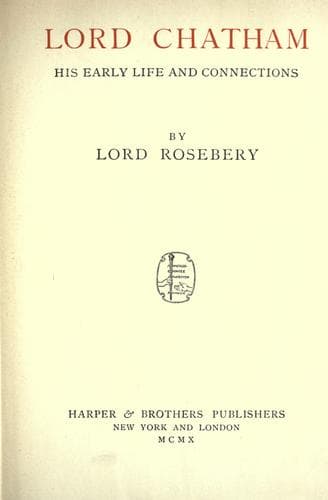
Lord Chatham, His Early Life and ConnectionsRosebery, Archibald Philip Primrose, Earl of
History
Lord Chatham, His Early Life and Connections
Rosebery, Archibald Philip Primrose, Earl of
Pitt, William, Earl of Chatham, 1708-1778
One Minister was now, however, to display a rare courage, and to oppose
both the King and his Minister on a critical point. In the middle of
August, after the conversation with Hardwicke, the treaty of subsidy
with Hesse-Cassel arrived for the necessary confirmations. When it came
before Legge as Chancellor of the Exchequer, he, no doubt with the
connivance of Pitt, flatly refused his signature. Newcastle had always
distrusted Legge, as, indeed, he distrusted everybody, and had given him
the seals of the Exchequer with great reluctance. He was now aghast. War
was imminent; the King would soon return with his pockets full of odious
treaties of subsidy; Fox was still a malcontent; Legge was in open
revolt; it was evident that he must face the formidable interview with
Pitt. So he expressed the necessary wish, though one may guess his
reluctance, and Pitt saw the Duke on September 2 (1755) for two hours
and a half. The record of this interview is contained in a long letter
from Newcastle to Hardwicke,[283] couched in the quavering notes of a
distracted Minister. It begins with a wail of despair, the reluctant
acknowledgment of the paramount importance of Pitt. 'I never sat down to
write to your lordship with more melancholy apprehensions for the
Publick than at present. I see nothing but confusion and it is beyond me
to point out a remedy.'
This was the result of Pitt's verbal refusal to join him, made by a
Minister who held the great mass of the House of Commons in the hollow
of his hand, who clung to office as to life, and yet, though he knew
Pitt was indispensable to its retention, would not once more, as in
1746, face his Sovereign and say so. Nothing can better illustrate the
trembling plank on which the Duke was content to walk, wavering and
helpless, depending only on Hardwicke's counsel and his own jobs. He did
not dare face the King, he was bullied by the disorderly chiefs in the
House of Commons, and he was always chaffering, but always afraid. So he
and his like are satisfied to bear the yoke for the semblance of power.
All began smoothly between Pitt and the Duke, all was apparently open,
friendly, and civil; but when Newcastle referred to the conversation
with Hardwicke, he was taken aback by finding that Pitt declared that
nothing had passed that was material. He thus compelled Newcastle to
recapitulate the points of policy, no doubt for purposes of comparison.
Public-domain text, read in full here on John Shaqi.
Reviews
Reviews
No reviews yet
Be the first to share your thoughts on this work.
Elsewhere in the archive
Join the Discussion
Join the discussion
Sign in to leave a comment or review.
Sign InorCreate an account