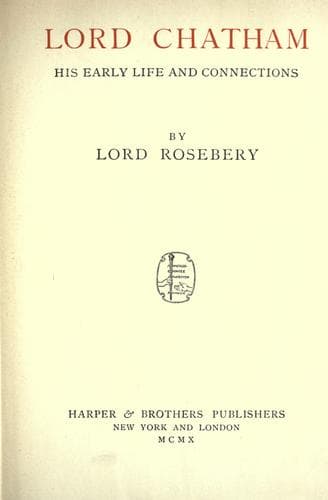
Lord Chatham, His Early Life and ConnectionsRosebery, Archibald Philip Primrose, Earl of
History
Lord Chatham, His Early Life and Connections
Rosebery, Archibald Philip Primrose, Earl of
Pitt, William, Earl of Chatham, 1708-1778
Robinson made less than no difficulties in accommodating himself to the
new pretensions. He only yearned to return to the Great Wardrobe of
which he had been Master. And so with a pension of 2000_l._ a year,
fixed upon luckless Ireland, he vanishes into space, with the natural
remark that he had never looked on his seven children with so much
satisfaction as on the completion of these domestic arrangements.
CHAPTER XIX.
This blank though important space in the life of Pitt himself seems
favourable for picking up a few threads which had to be dropped in the
narrative of his negotiations with Newcastle.
After the baiting to which Robinson had been subjected in the first days
of the session he disappeared from debate; and Fox, then in close
negotiation for a seat in the Cabinet, represented the Government in the
Commons, and turned a deaf ear to the proposal that he should join Pitt
in a combined attack on Newcastle. Fox's game, it will be seen, was not
calculated to win the confidence of Pitt, to whom, however, during the
session, he showed marked courtesy on the one hand, while negotiating
with the Duke on the other.
[Sidenote: Feb. 26, 1755.]
The Lord Advocate had introduced a Bill continuing for a further period
the provisions passed after the rising of 1745 which had temporarily
placed the tenure of sheriff-deputyships at the King's pleasure instead
of for life as before. This seems to have raised an animated debate,
memorable to us as having produced two fine speeches from Pitt, which
Horace Walpole alone mentions, and of which he gives a spirited sketch.
It is only possible to give Walpole's record in his own words, as there
is no other. Pitt spoke in answer to Murray (who, by-the-by, speaking
in defence of the Bill, had said that there was not a single Jacobite
left in Scotland) 'with great fire, in one of his best worded and most
spirited declarations for liberty, but which, like others of his fine
orations, cannot be delivered adequately without his own language; nor
will they appear so cold to the reader, as they even do to myself, when
I attempt to sketch them, and cannot forget with what soul and grace
they were uttered. He did not directly oppose, but wished rather to send
the Bill to the Committee, to see how it could be amended. He was glad
that Murray would defend the King, only with a salve to the rights of
the Revolution; he commended his abilities, but tortured him on his
distinctions and refinements. He himself had more scruples; it might be
a Whig delicacy--but even that is a solid principle. He had more dread
of arbitrary power dressing itself in the long robe, than even of
military power. When master principles are concerned, he dreaded
accuracy of distinction: he feared that sort of reasoning: if you class
everything, you will soon reduce everything into a particular; you will
then lose great general maxims. Gentlemen may analyse a question till it
is lost.
Public-domain text, read in full here on John Shaqi.
Reviews
Reviews
No reviews yet
Be the first to share your thoughts on this work.
Elsewhere in the archive
Join the Discussion
Join the discussion
Sign in to leave a comment or review.
Sign InorCreate an account