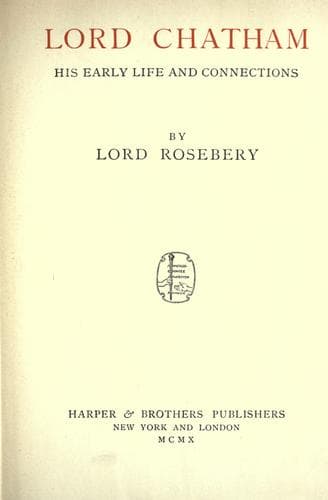
Lord Chatham, His Early Life and ConnectionsRosebery, Archibald Philip Primrose, Earl of
History
Lord Chatham, His Early Life and Connections
Rosebery, Archibald Philip Primrose, Earl of
Pitt, William, Earl of Chatham, 1708-1778
Murray followed with covert but bitter innuendoes; defended Pelham's
reduction of 2000 men, and had thought that that Minister had at least
died in friendship with Pitt. This again brought Pitt on his feet to say
that his friendship for Pelham had been as real as Murray's. Murray
continued coolly. The sting of his waspish speech was in its tail. He
wanted to clear up one particular point for his own information. He
understood Pitt to say that he had refused the Secretaryship of State:
pray, had he?
He had his enemy at the point of the sword. Pitt had certainly, as we
have seen, with incredible rashness, at least insinuated this, if not
declared it. He now had to rise and eat his words: 'he had only refused
to come into measures'![309]
Walpole apologises for recording this debate, tedious as it is, at such
a length. We must do the same, and his excuse is ours. Little was said
on the question, and indeed there was scarcely a question to discuss.
But the points of the speeches, so far as we can discern them, throw
light on the speakers, more especially on the reckless, impetuous
character of Pitt, even at this time.
CHAPTER XX.
The bombardment of the new Ministry continued without intermission, for
Pitt was determined to wreak his vengeance on Newcastle and Fox. We may,
moreover, presume that, seeing the critical condition of affairs and the
incompetence of the Ministry to wrestle with them, he, conscious of
great powers, was determined to become a directing Minister. He was now
forty-seven, in the full ripeness of character and intellect. Neither he
nor the country could afford to wait.
[Sidenote: Dec. 2, 1755.]
Ten days after the last debate, Lord Pulteney, the sole and short-lived
hope of his famous father, introduced a Bill to give the prizes captured
before a declaration of war to the seamen who had captured them, should
war be afterwards declared. Pitt and his section intervened, and the
engagement developed from a skirmish into a battle. The debate turned
largely on pressing; that practice having brought great complaints from
Scotland, where 'mobs are more dangerous and more mischievous than our
mobs in England, not contenting themselves with clubs and bludgeons, but
possessing themselves of as many firearms and other mortal weapons as
they can possibly come at.' This perhaps was not wonderful, when it was
admitted that a gang had surrounded a church, and pressed part of the
congregation as it came out. But it soon soared from that point to the
question of our relations with France.
Public-domain text, read in full here on John Shaqi.
Reviews
Reviews
No reviews yet
Be the first to share your thoughts on this work.
Elsewhere in the archive
Join the Discussion
Join the discussion
Sign in to leave a comment or review.
Sign InorCreate an account