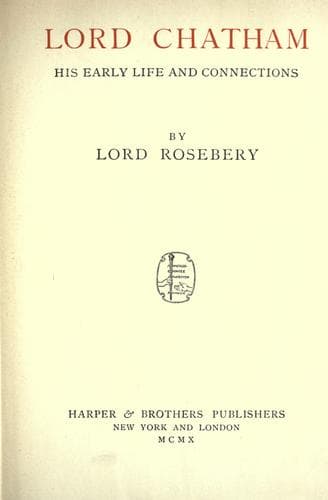
Lord Chatham, His Early Life and ConnectionsRosebery, Archibald Philip Primrose, Earl of
History
Lord Chatham, His Early Life and Connections
Rosebery, Archibald Philip Primrose, Earl of
Pitt, William, Earl of Chatham, 1708-1778
Fox opposed the Bill, which he said would be considered as a veiled
declaration of war. France was patient because she wished to persuade
her allies that we were the aggressors, and so induce them to join her.
The passing of the Bill would furnish the very proof she required. The
whole gist of the matter lay in the word 'now,' 'the hinge,' he said
with a painful confusion of metaphor, 'upon which the very marrow of
this debate must turn.' Were peace hopeless such a Bill might be
necessary; now it could only do harm. Pitt followed Fox and made play
with the word 'now,' for as Murray said in reply: 'He has the happy
faculty of being able to turn the most important word, the most serious
argument, into ridicule.' He pointed out from examples in the reign of
Elizabeth and Charles II. that we might be at war for many years without
declaring war, and supported the Bill; as did Richard Lyttelton (though
the House, says Rigby, can no longer be brought to hear a word from
him), and George Grenville. The most piquant part of the speeches of
both Pitt and Fox related to Walpole, who had now from a bugbear become
a fetish. Fox pronounced a high eulogy upon him, but denied that his
parliaments had been venal. Pitt said that he himself had always opposed
Walpole when in power, but after resignation had always 'spoken well of
him as a man.' Here there was a laugh, which Pitt angrily rebuked. Was
it not more honourable to respect a man when his power had come to an
end than before? Walpole had no doubt 'for many years an amazing
influence in this House, and the enquiry, stifled as it was, made it
pretty evident from whence that influence proceeded!' Legge swelled the
chorus of devotion to a Minister who had scarce a friend at his fall,
by declaring that 'he was an honour to human nature and the peculiar
friend to Great Britain!' Death, in British politics, magnanimously
closes most accounts with a credit balance.[310]
[Sidenote: Dec. 5, 1755.]
Three days afterwards, Barrington, the new Secretary at War, moved the
Army Estimates. Here we are again thrown upon Walpole, whose records,
precious as they are, are the notes of an amateur, jotted down at the
time with the idea of subsequent expansion, but not subsequently
expanded. Indeed, when he came to use them, his memory, it is probable,
no longer availed for the purpose. But from the account of the last
debate on December 2, 1755, the Parliamentary history, incredible as it
may seem, records no speech of Pitt's till the last month of 1761, and
then only a formal reply.
Public-domain text, read in full here on John Shaqi.
Reviews
Reviews
No reviews yet
Be the first to share your thoughts on this work.
Elsewhere in the archive
Join the Discussion
Join the discussion
Sign in to leave a comment or review.
Sign InorCreate an account