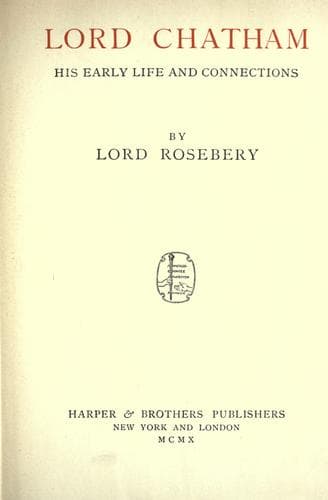
Lord Chatham, His Early Life and ConnectionsRosebery, Archibald Philip Primrose, Earl of
History
Lord Chatham, His Early Life and Connections
Rosebery, Archibald Philip Primrose, Earl of
Pitt, William, Earl of Chatham, 1708-1778
The House promptly voted a million on account, but Pitt as usual uttered
eloquent lamentations on the incapacity of Ministers and the calamitous
situation of affairs. What was this vote of credit for? Was it to raise
more men? We had already 40,000 British and 14,000 foreign troops. Was
it for the purpose of marine treaties? Then he would joyfully vote it.
For a naval war we could and ought to support, but a Continental war on
the present system we could not. Regard should no doubt be had to
Hanover, but a secondary regard. For if Hanover was to be our first
object it would lead us to bankruptcy. It was impossible to defend
Hanover by subsidies. How could an open country be defended against an
enemy who could march 150,000 men into it, and if necessary reinforce
them by as many more? Should Hanover suffer by her connection with Great
Britain, we ought not to make peace without exacting full and ample
compensation for all the damage and injury she might have sustained. But
the idea of defending Hanover by subsidies was preposterous, absurd, and
impracticable. Then, excited by this favourite theme beyond the limits
he had imposed on himself, he struck home at the King and his darling
patrimony. This system, he said, would in a few years, cost us more
money than the fee simple of the electorate was worth, a place which
after all could not be found in the map. He ardently wished us to break
those fetters which chained us like Prometheus to that barren rock. (The
metaphor which made a rock of Hanover does not strike one as one of his
happiest efforts).
If Lyttelton could not state the purpose for which this credit was
designed, perhaps he could say for what it was not designed. Still, Pitt
added sardonically, he was of so compounding a temper that he should
assent to it.
Ministers bragged of their unanimity and spirit. But what had all this
army of councils and talents, this universal aye, produced? Were we
safe? Had we inflicted any damage on the enemy? If so, when and where?
He had no particular pleasure in thus speaking. He did not wish to load
the unhappy men who had undone their country, most unhappy if they did
not realise it. And our activity! Philosophers indeed had a phrase _vis
inertiæ_ by which they denoted the inactivity of action (_sic_). Was it
by that that we were to be saved?
His charge against the Government was this: that we had provoked before
we could defend, and neglected after provocation; that we were left
inferior to France in every quarter; that the vote of credit had been
misapplied to secure Hanover; and that we had bought a treaty with
Prussia by sacrificing our rights. He would not have signed such a
treaty to have the five great places of those who had signed it. Yet if
this treaty were restrained to the defence of the King's dominions he
should not know how to oppose it.
Public-domain text, read in full here on John Shaqi.
Reviews
Reviews
No reviews yet
Be the first to share your thoughts on this work.
Elsewhere in the archive
Join the Discussion
Join the discussion
Sign in to leave a comment or review.
Sign InorCreate an account