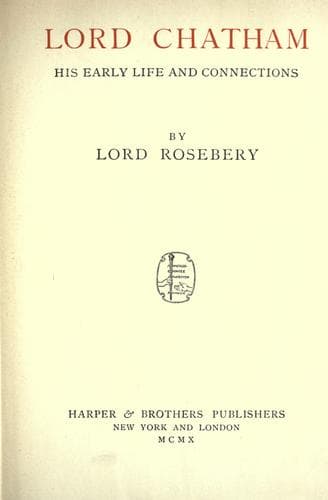
Lord Chatham, His Early Life and ConnectionsRosebery, Archibald Philip Primrose, Earl of
History
Lord Chatham, His Early Life and Connections
Rosebery, Archibald Philip Primrose, Earl of
Pitt, William, Earl of Chatham, 1708-1778
He had no feeling of resentment against the Government, no one had
injured him. Yet he could not but think ill of their capacity and their
measures. Could he, then, every day, arraign their policy and feel
confidence in them? Pelham indeed had intended economy, but he was
dragged into this foreign policy by his brother, now at the head of the
Treasury. And if he, Pitt, saw Newcastle like a child driving a go-cart
with that precious freight of an old King and his family on to a
precipice, was he not bound to try and take the reins from his hands?
And with a gloomy foreboding which must have chilled the anxious House,
he solemnly prayed that the King might not have Minorca written on his
heart, as Calais had been, in the dying declaration of Mary, engraved on
hers.
The debate ended with a bitter rally between Pitt and Lyttelton, the
fiercer for their former friendship. Lyttelton had sneered at his
epithets. This came well, said Pitt, from Lyttelton, whose own character
was a composition of epithets. He himself had used no epithets that day,
so Lyttelton had chosen ill the occasion for his taunt. But in any case
the House was not an academy for the exchange of compliments. And when
Lyttelton disclaimed any share in framing the motion, it was obvious
that he was not at liberty to change it. If Lyttelton would declare that
he had no more resources, he would only say that Lyttelton was
incapable.
The new Chancellor of the Exchequer, whose heart was still warm with his
old affection, was hurt by this attack, but he maintained his ground.
'He says I am but a thing made up of epithets. Is not this the language
of Billingsgate? The world is complaining that the House was turned into
a bear garden. I do not envy my friend the glory of being the Figg or
Broughton of it.' Pitt retorted that Lyttelton was a very pretty poet,
and that there was no one whom he more respected pen in hand. 'But it is
hard that my friend, with whom I have taken sweet counsel in epithets,
should now reproach me with using them.' Lyttelton replied once more
that it was not his fault if he and Pitt were not still friends.[322]
[Sidenote: May 14, 1756.]
A day or two later Lyttelton unfolded to the House the provisions of the
Treaty of Westminster. It had cleared up some small pecuniary claims on
both sides, so much to Frederick for losses from British privateers, so
much from Frederick for arrears of interest on the Silesian loan, a
balance of 40,000_l._ due on the whole to Great Britain. On this, Pitt,
inveterate against the Ministry, fulminated once more. He declared that
by payment, even of a small sum, we had conceded the principle of our
Empire over the sea, and went off into the usual rhetoric. 'For himself
he should affect no superiority but what was common to him with the
twelve millions of his countrymen, innocence of his country's ruin, the
superiority of the undone over the undoers.'
Public-domain text, read in full here on John Shaqi.
Reviews
Reviews
No reviews yet
Be the first to share your thoughts on this work.
Elsewhere in the archive
Join the Discussion
Join the discussion
Sign in to leave a comment or review.
Sign InorCreate an account