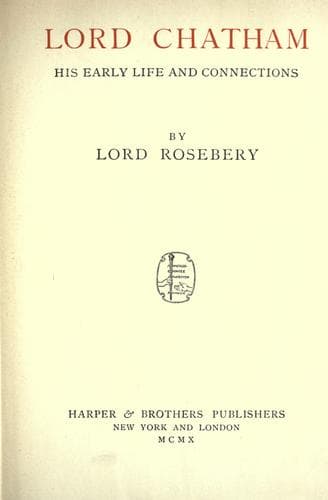
Lord Chatham, His Early Life and ConnectionsRosebery, Archibald Philip Primrose, Earl of
History
Lord Chatham, His Early Life and Connections
Rosebery, Archibald Philip Primrose, Earl of
Pitt, William, Earl of Chatham, 1708-1778
The House had risen on May 27. Two days earlier occurred an event which
was to remove one of the three intellects of the Government, Fox and
Hardwicke, of course, being the other two. Ryder, the Chief Justice of
the King's Bench, died, and Murray at once laid claim to the succession.
This demand drove Newcastle to despair. He offered Murray exorbitant and
increasing terms to remain, for he regarded Murray as his sole protector
in the House of Commons against his doubtful friend, Fox, and his open
enemy, Pitt. But offers of the Duchy of Lancaster for life with a
pension of 2000_l._ a year, with permission to remain Attorney-General
at a salary of 7000_l._ a year, and a reversion of one of the Golden
Tellerships of the Exchequer for his nephew Stormont, left Murray
unmoved. For months the game of temptation was played. At the beginning
of October the Prime Minister had raised the proposed pension to
6000_l._ a year. Murray remained firm. He stipulated, indeed, for more
than the Chief Justiceship; he demanded a peerage as well; he would not
take the one without the other; and in no case would he remain
Attorney-General. We can imagine Newcastle's tears and caresses; they
were in vain. Vain, too, was his attempt to fob off his rebellious
subordinate with the reluctance of the King. Murray, indeed, hinted that
when he became a private member of the House of Commons he might go into
Opposition. We may be sure, at any rate, that he had no intention of
facing an angry nation and Parliament in defence of Newcastle and the
loss of Minorca. This hint probably clinched the matter. Newcastle
capitulated; though, said Fox, from 'wilful trifling,' he deferred the
performance of his promise as long as possible.[326] It was not till the
eve of the Duke's fall that, on November 8, Murray was sworn in as Chief
Justice and created a Peer as Lord Mansfield.
[Sidenote: 1756.]
What glimpses are there meanwhile of Pitt? He had just got possession of
Hayes, and was there in May, building and improving, as usual, but
speaking brilliantly on the Militia Bill in the House, so brilliantly as
to earn a patronising note of approval from Bute, beginning 'My worthy
friend'; an indication that the bond between Pitt and the young Court
was now close. Indeed, Pitt seems now to have been the principal adviser
of that increasingly powerful connection.
Public-domain text, read in full here on John Shaqi.
Reviews
Reviews
No reviews yet
Be the first to share your thoughts on this work.
Elsewhere in the archive
Join the Discussion
Join the discussion
Sign in to leave a comment or review.
Sign InorCreate an account