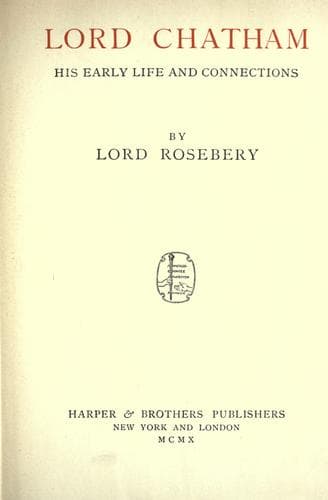
Lord Chatham, His Early Life and ConnectionsRosebery, Archibald Philip Primrose, Earl of
History
Lord Chatham, His Early Life and Connections
Rosebery, Archibald Philip Primrose, Earl of
Pitt, William, Earl of Chatham, 1708-1778
Potter, whom Pitt had come to describe as 'one of the best friends I
have in the world,' wrote to Pitt, ten days after Ryder's death,
conveying the news from an inspired source that if Murray went on the
bench Newcastle would invite Pitt to join the Government, for he could
repair the loss in no other way. But he adds, shrewdly enough, that the
Duke was evidently ignorant of his own strength, for if he had to rely
on Lyttelton and Dupplin (then Joint Paymaster of the Forces) alone,
though the debates would no doubt be shorter, he would not, such was the
temper of the House, lose a single vote. He added that, in his judgment,
the Opposition had not made themselves popular by their conduct, because
of the fear of invasion. Hanover treaties and Hanover troops had become
popular; opposition to them must be wrong 'when we are ready to be eat
up by the French.'[327]
But these anticipations were premature, for the struggle with Murray
lasted, as we have seen, from May till November. So that Pitt had
leisure to squander on his improvements and to receive his eldest son
John on John's entrance into the world. But his eye was vigilantly fixed
on the distresses of the country. 'Quæ regio in terris nostri non plena
laboris?' he writes to George Grenville (June 5, 1756). 'It is an
inadequate and a selfish consolation, but it is a sensible one, to think
that we share only in the common ruin, and not in the guilt of having
left us exposed to the natural and necessary consequences of
administration without ability or virtue.' Grenville, determined not to
be undone, replies in a letter stuffed with Latin quotation. 'Distress,'
rejoins Pitt (June 16, 1756), 'infinite distress seems to hem us in on
all quarters. I am in most anxious impatience to have the affair in the
Mediterranean cleared up. As yet nothing is clear but that the French
are masters there, and that probably many an innocent and gallant man's
honour and fortune is to be offered up as a scapegoat for the sins of
the Administration.' In July he paid a visit at Stowe, and in August he
was laid up at Hayes with 'a very awkward, uneasy, but not hurtful'
malady.
He must have seen with poignant interest Frederick's fierce irruption
into Saxony, but all seems absorbed in his anxiety for his wife and his
overflowing delight at the birth of his son. This event occurred on
October 10, at a moment when the ministerial crisis had become acute.
Public-domain text, read in full here on John Shaqi.
Reviews
Reviews
No reviews yet
Be the first to share your thoughts on this work.
Elsewhere in the archive
Join the Discussion
Join the discussion
Sign in to leave a comment or review.
Sign InorCreate an account