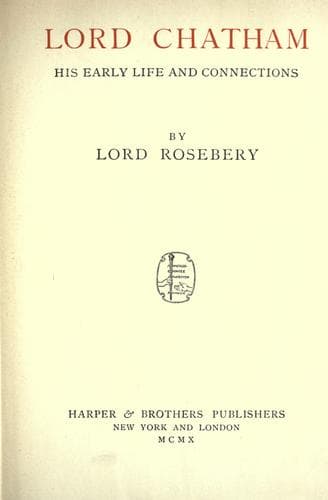
Lord Chatham, His Early Life and ConnectionsRosebery, Archibald Philip Primrose, Earl of
History
Lord Chatham, His Early Life and Connections
Rosebery, Archibald Philip Primrose, Earl of
Pitt, William, Earl of Chatham, 1708-1778
No one in fact was willing to face even an abject House of Commons with
the loss of Minorca on his back. Newcastle was near the end of his
tether. Murray had gone. Whether Chief Justice or not, he was determined
to be out of the Ministry; and if disappointed of his just claim to the
Bench he was not likely to face a storm on behalf of the Minister who
had refused it. Murray had gone, Fox was going; for his chagrin was
patent, and Newcastle 'treated him rather like an enemy whom he feared
than as a minister whom he had chosen for his assistant.' He was no
better used by the King. The Duke, moreover, was at war with the waxing
power of Leicester House. With this Court indeed he managed to patch up
a hollow peace at the expense of Fox; offending one Court and not
appeasing the other. But that did not help him to an agent in the House
of Commons.
And worse was still to come, disaster followed on disaster. To a nation
freshly smarting with the fall of Minorca there came tidings of
catastrophe from the East and the West. In June Calcutta had been
captured by Surajah Dowlah, followed by the horrors of the Black Hole,
which still linger in the proverbial dialect of this country. Then in
August fell Oswego, the most important British fortress in North
America. Situated on Lake Ontario it was a permanent menace to the
French, for British command of that lake would mean the separation of
Canada from Louisiana. Montcalm, a general of high merit, who has had
the singular good fortune to leave a name consecrated by the common
veneration of friend and foe, had arrived to take the command of the
French forces in Canada. Two months after landing he marched on Oswego,
and, investing it with a greatly superior force, soon compelled it to
capitulate. Its garrison of 1400 men surrendered as prisoners of
war.[328] A hundred pieces of artillery and great stores of ammunition
fell into the hands of the French. The forts, three in number, and the
vessels were burned. It was a real triumph for the French, and a
proportionate disaster for their foes. 'Such a shocking affair has never
found a place in English annals,' wrote one American officer. 'The loss
is beyond account; but the dishonour done his Majesty's arms is
infinitely greater.' 'Oswego,' wrote Horace Walpole, 'is of ten times
more importance even than Minorca.'
Public-domain text, read in full here on John Shaqi.
Reviews
Reviews
No reviews yet
Be the first to share your thoughts on this work.
Elsewhere in the archive
Join the Discussion
Join the discussion
Sign in to leave a comment or review.
Sign InorCreate an account