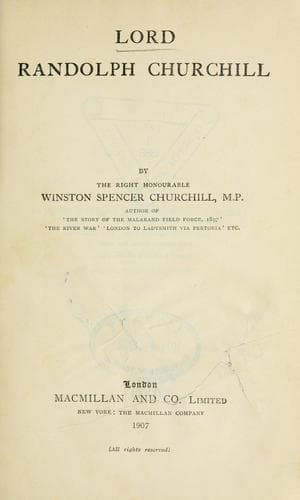
Churchill, Randolph Henry Spencer, Lord, 1849-1895
‘But if the right honourable member for Westminster were to propose to
the Committee that he himself should have a vote at Parliamentary
elections and that I should have none, I feel sure the House of Commons
would repudiate the proposal with indignation and disgust.’ The
‘mud-cabin’ argument seems after this to have disappeared altogether
from Parliamentary warfare and Mr. Brodrick’s amendment was rejected by
the enormous majority of 332 to 137. After this the resistance of the
Opposition in the House of Commons was at an end. The third reading of
the Bill was allowed to pass _nemine contradicente_ and entered
accordingly on the journals of the House. The Bill then went to the
House of Lords at the end of June; and there, by amendments supported by
majorities of 59 and 50, it was incontinently destroyed. The collision
between the two Houses was direct, and a dangerous excitement arose in
the country.
Although unwilling to impede the progress of the Reform Bill and
decidedly predisposed to take action contrary to the views of his own
pastors above the gangway in order to put a spoke in their wheel, Lord
Randolph was the most unrelenting and vigilant opponent of the Liberal
Government. Whenever and wherever a favourable chance of fighting
occurred he was the foremost man, and many furious wrangles between him
and Mr. Gladstone, or Mr. Chamberlain or Sir Charles Dilke marked the
course of the session. In the quarrel between the two Houses after the
rejection of the Bill in the House of Lords, he exerted himself to his
utmost on behalf of the House of Lords and laid on the Prime Minister
the whole responsibility for the dangerous constitutional situation
which had arisen and was becoming increasingly grave. Hansard and the
newspapers record these battles in ample detail. Sometimes he found
powerful support. On one occasion, when a dispute arose with Sir Charles
Dilke as to the accuracy of a quotation from Lord Randolph’s speeches,
Sir Michael Hicks-Beach said abruptly that ‘he preferred to believe the
word of his noble friend to that of the right honourable baronet’--an
observation which he was required by the Speaker to withdraw. On another
occasion Lord Randolph charged the Prime Minister with having ‘traduced’
his opponents by representing that Lord Salisbury had said in the course
of a confidential conversation that he would not discuss Redistribution
‘with a rope round his neck,’ and he moved the adjournment of the House.
Mr. Gladstone, violently incensed, described this word ‘traduce’--which
he declared implied a wilful and disgraceful act, not arising from
error--as ‘foul language.’ Lord Randolph immediately rose to order, and
asked the Speaker whether the Prime Minister was to be allowed to use
words which would not be tolerated in any other member. The Speaker
hoped that Mr. Gladstone would not insist on employing the expression.
The Prime Minister’s reply was accepted as a withdrawal, though his
Public-domain text, read in full here on John Shaqi.
Reviews
Reviews
No reviews yet
Be the first to share your thoughts on this work.
Elsewhere in the archive
Join the Discussion
Join the discussion
Sign in to leave a comment or review.
Sign InorCreate an account