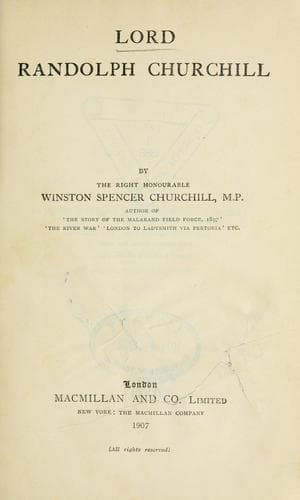
Churchill, Randolph Henry Spencer, Lord, 1849-1895
actual words do not favour that construction. It is said that this was
the only time in his whole career when Mr. Gladstone incurred the rebuke
of the Chair. Lord Randolph seems to have been distressed at having
offended his great antagonist so deeply. Later in the debate he rose
again. ‘Recollecting,’ he said, ‘the vast difference which separates me
from the Prime Minister, I wish to say that it never has been and never
will be my intention, during the many years I hope he will remain in
this House, to use language in any way incompatible with his lofty
position.’ Mr. Gladstone received this assurance with much magnificent
urbanity. ‘I was no doubt at the moment a little irritated at language
that I thought very strong; but on reflection I must own that the noble
lord has always been very courteous to me.’
But whether, in these vexed and protracted debates, Lord Randolph
Churchill attacked the Prime Minister or harassed his own leaders;
whether he was supported by loud applauses of Conservative members or
heard by them in chilly silence; whether he seemed to be the accepted
spokesman of the Opposition or a solitary politician--his hand against
every man and every man’s hand against him--his almost unerring eye for
a Parliamentary situation, his mastery over the House and his formidable
power for good or evil upon the fortunes of his party became continually
more evident. Alone, or almost alone, he waged his double warfare
against Government and Opposition. Assailed on all sides--from the
Ministerial box, from the Front Opposition Bench, from those who sat
before him and behind him and even beside him; confronted with his own
contradictory statements, now by one side, now by the other; rebuked by
the Prime Minister, repeatedly repudiated by his colleagues and
leaders, he nevertheless preserved throughout an air of haughty
composure and met or repelled all attacks with resourceful and undaunted
pluck. ‘Tory Democracy,’ said Mr. Chamberlain during a vehement speech
in favour of the Reform Bill (House of Commons, March 27), ‘of which we
shall hear a good deal in the future, is represented in this House by
the member for Woodstock. I pay the greatest attention to anything he
says because I find that what he says to-day his leaders say to-morrow.
They follow him with halting steps, somewhat unwillingly; but they
always follow him. They may not always like the prescription he makes up
for them; but they always swallow it.’
Public-domain text, read in full here on John Shaqi.
Reviews
Reviews
No reviews yet
Be the first to share your thoughts on this work.
Elsewhere in the archive
Join the Discussion
Join the discussion
Sign in to leave a comment or review.
Sign InorCreate an account