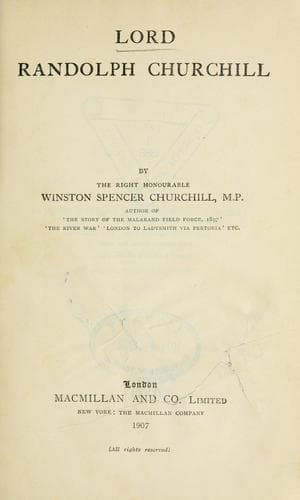
Churchill, Randolph Henry Spencer, Lord, 1849-1895
Towards the end, when he had his party thoroughly behind him, Lord
Randolph took occasion to declare, in the form of an elaborate eulogy
upon Sir Michael Hicks-Beach, his intentions as to the leadership of
the House of Commons. ‘I hear a great deal about the deplorable weakness
of the Opposition; but I did not detect any deplorable weakness in the
speech of the right honourable gentleman who proposed this motion; nor
did I detect any deplorable weakness in the sonorous and resonant cheers
which greeted that speech continually from beginning to end--a speech
with reference to which I may be permitted to remark that it was a
magnificent indictment, all the more magnificent because it was so
measured and so grave; and I think it must have recalled to the Prime
Minister himself the palmy days of Tory leadership.’
‘The Government,’ he concluded, ‘when they went to Egypt abandoned every
atom of principle which they possessed. Egypt has been a Nemesis to them
and will, I believe, be their ruin. But the whole question is at last,
thank God, presented to us in an intelligible form. Will you or will you
not rescue Gordon? Answer “Aye” or “No.” The people of England and
Scotland, and of Ireland also, I believe, say “Aye.”’ (Cries of “No”
from the Ministerial benches and cheers.) ‘The Prime Minister and a few
Radical fanatics say “No”; but great as is the Prime Minister’s power,
long as has been his career and dazzling as his eloquence is, the odds
against him on this question are so overwhelming that even he must
either submit or resign.’ The Government escaped defeat only by
twenty-eight votes. Thirty-one Home Rulers voted with the Tory party;
and fifteen, or enough to have carried the censure, voted with
Ministers. The debate and the division alike foreshadowed the events of
1885.
While the fortunes of battle in the House of Commons varied thus from
day to day, the attention of both factions in the National Union was
concentrated on the approaching Conference of delegates from all parts
of the country, when the new Council must be elected. The chairmanship
depended upon the complexion of the Council. Lord Percy, the official
candidate, and his friends entertained hopes that an appeal to the
delegates to stand by the official leaders of the party and to repudiate
disloyalty would result in the election of a Council hostile to Lord
Randolph Churchill. To this end nothing was neglected. A careful and
earnest canvass was set on foot, supported by all the influence which
the representatives of the old and high Toryism could command.
Sheffield, it appears, was specially selected for the meeting-place, as
the local members were hostile to Lord Randolph; and that authority in
its highest embodiment should not be lacking, Lord Salisbury himself
undertook to address the assembled delegates at the evening meeting.
Public-domain text, read in full here on John Shaqi.
Reviews
Reviews
No reviews yet
Be the first to share your thoughts on this work.
Elsewhere in the archive
Join the Discussion
Join the discussion
Sign in to leave a comment or review.
Sign InorCreate an account