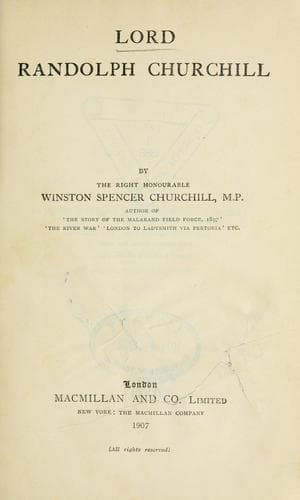
Churchill, Randolph Henry Spencer, Lord, 1849-1895
But now a strange and unexpected turn was given to the course of events.
Lord Randolph Churchill’s victory, remarkable as it was, had been
narrowly won. A powerful and inflamed minority remained upon the Council
of the National Union to hamper and assail the leader of Tory Democracy.
The proverbial three courses lay before him. To renew his chairmanship
and to continue an internecine quarrel up to the very verge of the
General Election; to withdraw for a time from public life; or to make a
peace with Lord Salisbury. He chose the third. Sir Henry Wolff was
authorised to open negotiations. Mr. Balfour’s good offices were freely
tendered. Lord Salisbury was prompt in seizing the opportunity. Indeed,
the suicidal results to the principals and to their party of a
continuance of the quarrel were obvious. Terms of reconciliation were
speedily arranged. The Central Committee was abolished, and the
democratic reforms in the organisation of the National Union were
confirmed; the Primrose League was formally recognised and supported by
the official leaders. Sir Michael Hicks-Beach, who had been elected to
the Council of the National Union as an independent member on the list
of neither contending faction, and who was liked and trusted by both
sides, was nominated as the new Chairman. There was, moreover, a
general understanding that Lord Randolph Churchill and his friends were
to act in harmony with Lord Salisbury and were to be treated with full
confidence by him and the ruling members of the Conservative party.
Such were the conditions, so far as they could be, or have ever been,
put on paper. But it is evident that their moral consequences were of
much graver importance. No record has been preserved of what passed at
the interview between Lord Randolph Churchill and Lord Salisbury. But
certain very significant facts are plain. Lord Salisbury did not select
a lieutenant. He formed an alliance on terms of comradeship for the
general advantage of the party. The two men met as chiefs of almost
equal powers. Although Lord Salisbury’s primacy was never disputed by
Lord Randolph Churchill, they exercised from the very first a divided
authority; and it is in the light of this unusual relationship--based
not, indeed, upon any definite agreement, but arising out of the hard
facts of the situation--that the conduct of both, amid the political
turbulence of the next two years, can alone be fairly judged.
Public-domain text, read in full here on John Shaqi.
Reviews
Reviews
No reviews yet
Be the first to share your thoughts on this work.
Elsewhere in the archive
Join the Discussion
Join the discussion
Sign in to leave a comment or review.
Sign InorCreate an account