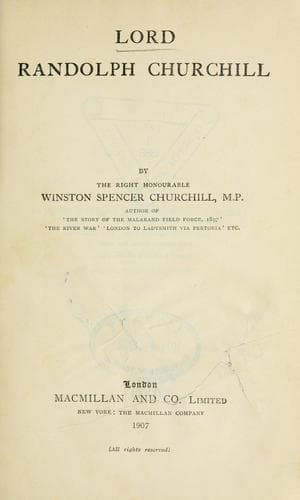
Churchill, Randolph Henry Spencer, Lord, 1849-1895
Lord Salisbury was loyal throughout to Sir Stafford Northcote, even in a
degree which was often detrimental to party interests. But, whatever his
wishes may have been, the settlement of the National Union dispute
sealed that unfortunate statesman’s fate--so far as the leadership of
the House of Commons was concerned. The dinner to which, in celebration
of the peace, Lord Salisbury invited the Council of the National Union,
including a majority of those who had been his most active opponents
during the past year, was the public acceptance of Tory Democracy in the
councils of the Conservative party. The great meeting held in the Pomona
Gardens at Manchester in August and addressed by Lord Salisbury, Lord
Randolph Churchill, and Sir Michael Hicks-Beach, was a plain indication
of the Cabinet and Parliamentary arrangements which would be a necessary
consequence of that acceptance.
Sir Henry Wolff, who had been throughout these conflicts Lord Randolph’s
most intimate and trusted friend, entirely approved of the steps which
had been taken to end the quarrel.[24] Mr. Gorst also wrote to Lord
Randolph on July 27, 1884, expressly and explicitly signifying his
concurrence and describing Lord Randolph Churchill’s refusal to continue
as Chairman of Council of the National Union as ‘a good stroke of
policy.’ But it has since been suggested, upon apparently unimpeachable
authority,[25] that Mr. Gorst disapproved of the reconciliation; that he
thought greater advantage to the Conservative party would have followed
from the prosecution of the dispute; and that he conceived himself in
some measure deserted by its abandonment. Of Lord Randolph’s behaviour
to his able, energetic supporter the reader will be able to judge before
the story is complete. But there is no doubt that Mr. Gorst was for a
time, after the _concordat_, in a position of much weakness and
isolation. He had incurred very bitter enmities by the part he had taken
in the quarrel. It was especially resented that those talents of
organisation which had so greatly aided the Tory victory of 1874, should
have been employed against the recognised leaders of the Conservative
party ten years later. Men who did not think it wise, in view of what
had happened in the past, and still more of what might happen in the
future, to anger Lord Randolph Churchill, were glad enough to indulge
their spite upon Mr. Gorst. His real feeling--that he had been thrown
over--must have become apparent to Lord Randolph Churchill, in spite of
his written agreement in the course adopted; and a coolness ensued
between them, diversified with occasional heats.
Public-domain text, read in full here on John Shaqi.
Reviews
Reviews
No reviews yet
Be the first to share your thoughts on this work.
Elsewhere in the archive
Join the Discussion
Join the discussion
Sign in to leave a comment or review.
Sign InorCreate an account