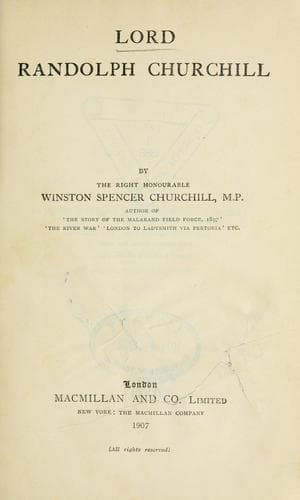
Churchill, Randolph Henry Spencer, Lord, 1849-1895
These charges were furiously denied, and were no doubt exaggerated in
form; but they bore a sufficiently accurate and substantial relation to
circumstances well within the knowledge of Birmingham citizens to be
highly damaging. Moreover, the argument that the Radical party, although
already possessed of all the machinery of national government, were
preparing--by the abolition of the Second Chamber on the one hand, and
the suppression of public meetings on the other--to subvert the
Constitution and to enter upon revolutionary paths, gained acceptance in
England far beyond the ordinary limits of Conservative opinion.
So soon as Parliament met, a week later, for the winter session, Lord
Randolph placed upon the paper an amendment to the Address taking the
form of a vote of censure on Mr. Chamberlain for speeches which
encouraged interference with freedom of discussion and incited to riot
and disorder. The debate was heralded for several days by much
preliminary snarling. Mr. Chamberlain, irritated by constant
cross-questioning, referred to Sir Henry Wolff as Lord Randolph
Churchill’s ‘jackal.’ ‘With his usual insolence,’ observed Sir Henry
Wolff in reply; and, on being rebuked by the Speaker, he substituted
‘with his usual courtesy.’ Mr. Chaplin inquired whether the President of
the Local Government Board would not proceed to describe his opponents
as ‘hyænas’; and Lord Randolph Churchill, availing himself of the
Speaker’s ruling that the word ‘jackal,’ if looked upon as a figurative
expression, was not out of order, proceeded to state that at the
earliest possible opportunity he would move his amendment and ‘draw the
badger.’
Public-domain text, read in full here on John Shaqi.
Reviews
Reviews
No reviews yet
Be the first to share your thoughts on this work.
Elsewhere in the archive
Join the Discussion
Join the discussion
Sign in to leave a comment or review.
Sign InorCreate an account